Welcome to KnowHow Daily!
Practical guides, money-saving tips, tech solutions, government benefits, and useful information for everyday life.
Welcome to KnowHow Daily!
Practical guides, money-saving tips, tech solutions, government benefits, and useful information for everyday life.

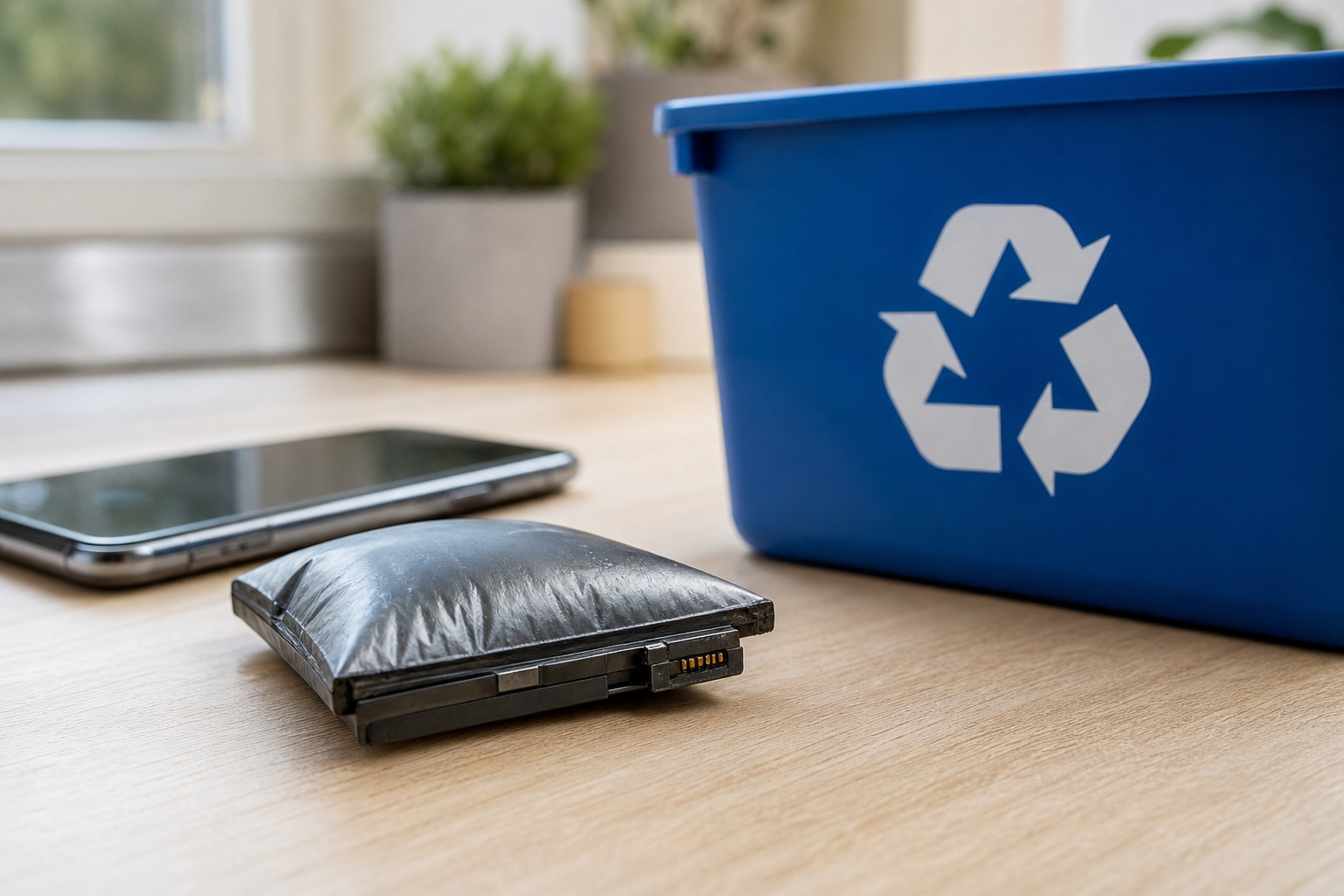
Learn how to dispose of used, swollen, damaged, and embedded lithium-ion batteries safely in the United States and Canada.

Used lithium-ion batteries belong at a specialized battery drop-off site, electronics recycler, or household hazardous-waste facility—not in your household trash and not in curbside recycling. That includes batteries in phones, laptops, power banks, cordless tools, e-bikes, scooters, cameras, tablets, toys, and other rechargeable products.
The reason is practical: a battery that still holds a charge can be crushed, punctured, or short-circuited during collection and sorting. That can start a fire in a garbage truck, recycling facility, or landfill. The recycling symbol on a battery does not mean it belongs in your blue bin. It means the battery should go through a specialized recycling program.
The most important distinction is whether the battery is intact and used or swollen, damaged, leaking, hot, recalled, or otherwise unsafe. Those batteries need different handling.

If the battery is flat, cool, dry, and not visibly damaged, follow these steps:
Do not tape over labels or safety information if the collection program needs to identify the battery. Do not put several loose batteries together in a drawer, box, or shopping bag where their terminals can touch.
If the battery is built into a phone, laptop, tablet, toothbrush, vacuum, or other device, do not pry it out unless the manufacturer specifically designed that step for consumers. Take the complete device to an electronics-recycling or hazardous-waste program that accepts products with rechargeable batteries.
Swelling usually means the battery has been damaged internally. Other warning signs include a dented case, torn wrapper, unusual odor, hissing, leaking fluid, excessive heat, smoke, or a battery that no longer fits correctly in its compartment.
Do not use, charge, squeeze, puncture, bend, dismantle, or place a swollen battery in a normal battery-recycling box. Do not try to flatten it or force it out of a device. A swollen phone, laptop, or power bank should be treated as a damaged battery even if it still appears to work.
If there is no immediate sign of fire, move people and pets away from the area and keep the battery or device away from curtains, paper, gasoline, furniture, and other flammable materials. Avoid unnecessary handling. Contact the product manufacturer, the retailer, or your local household-hazardous-waste program for specific instructions before transporting it.
EPA guidance says a damaged device may be temporarily kept in a safe location, such as a container with a fire-suppressing material like sand or kitty litter, when there is no imminent fire threat. Local authorities or the manufacturer may give different instructions, so follow the direction that applies to your battery and location.
If the battery is hot, smoking, hissing, sparking, leaking, or on fire, do not pick it up or carry it outside. Leave the area, close doors if you can do so safely, and call 911 or your local emergency number. Tell responders that a lithium-ion battery is involved.
For an intact removable battery, use a program that lists lithium-ion or rechargeable batteries as an accepted material. Call ahead or check the current listing because participating locations may accept only certain sizes, brands, or battery types.
In the United States, The Battery Network locator lets you search by ZIP code and select rechargeable, e-bike, or high-energy battery categories. Its standard collection boxes are not for damaged or defective batteries, although some states have trained locations with additional capabilities.
Find a U.S. battery drop-off location through The Battery Network locator
In Canada, Recycle Your Batteries, Canada! provides a province-aware drop-off search through Call2Recycle. For a swollen, leaking, or otherwise damaged battery, contact the location or your municipality first rather than assuming the public collection box can accept it.
Find a Canadian battery drop-off location through Recycle Your Batteries, Canada!
EPA also recommends contacting your local solid-waste authority or household-hazardous-waste program. Local rules can be stricter than general national guidance, and some municipalities operate special collection events or permanent depots.
Find U.S. state hazardous-waste contacts| Situation | United States | Canada |
|---|---|---|
| Intact household lithium-ion battery | Use a specialized battery recycler, participating retailer, electronics recycler, or household-hazardous-waste facility. | Use a municipal program, participating retailer, or Call2Recycle collection site that accepts the battery type. |
| Swollen or damaged battery | Contact the manufacturer, local household-hazardous-waste program, or state waste agency. Do not use a standard collection box. | Health Canada says to check with your municipality. Contact the manufacturer or collection program before transporting the battery. |
| Battery built into a device | Do not remove it unless designed for consumer removal; use an electronics or hazardous-waste program. | Follow the same principle and confirm the municipality or recycler accepts the complete device. |
| E-bike, scooter, or large battery | Contact the manufacturer, dealer, or a program that specifically accepts high-energy batteries. | Contact the manufacturer, dealer, municipality, or an e-mobility collection program. |
If it is intact and removable, isolate the terminals and take it to a confirmed battery-recycling location. If it is embedded, leave it in the device and use an electronics or hazardous-waste program. If it is swollen, damaged, hot, leaking, smoking, or recalled, do not place it in a standard collection box—contact the manufacturer or local hazardous-waste authority first. If there is smoke, fire, or immediate danger, leave the area and call 911.
A. No. A battery can retain enough energy to spark even when it no longer powers a device. Treat used lithium-ion batteries as rechargeable battery waste and take them to a confirmed battery-recycling or household-hazardous-waste location.
A. Only use temporary storage guidance from your manufacturer, local hazardous-waste authority, or emergency officials. EPA describes sand or kitty litter as a possible fire-suppressing material when there is no imminent fire threat, but a swollen battery should not be handled unnecessarily or taken to an ordinary collection box.
A. Not unless the product is specifically designed for safe consumer removal. Opening or prying into a sealed device can puncture the battery. Contact the manufacturer, retailer, or local hazardous-waste program for instructions.
A. Not automatically. E-bike and scooter batteries are larger high-energy batteries, and programs may have separate limits, packaging, or participating locations. Contact the manufacturer, dealer, municipality, or a program that specifically lists e-mobility batteries.