Welcome to KnowHow Daily!
Practical guides, money-saving tips, tech solutions, government benefits, and useful information for everyday life.
Welcome to KnowHow Daily!
Practical guides, money-saving tips, tech solutions, government benefits, and useful information for everyday life.

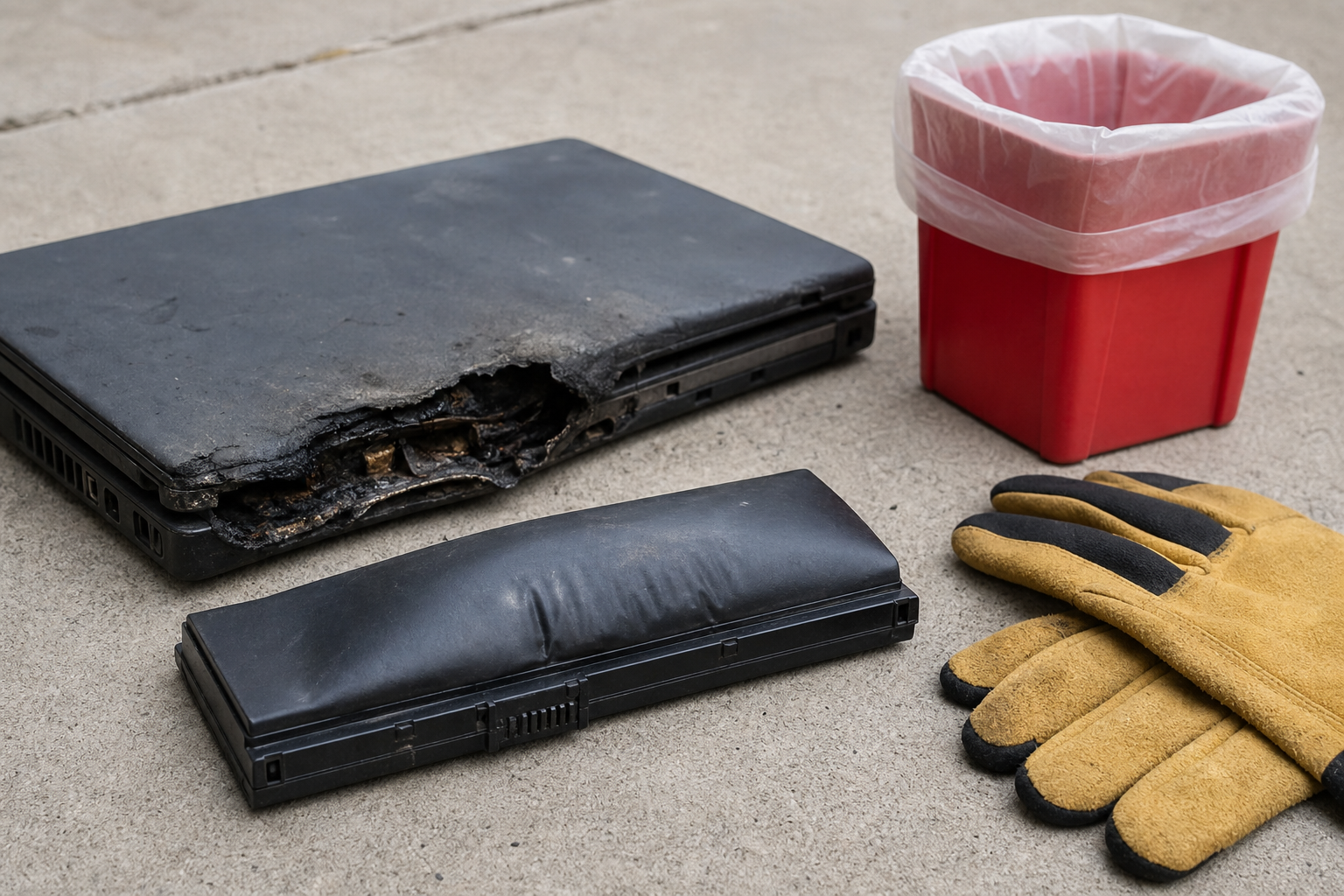
Have a swollen, leaking, dented, or damaged lithium-ion battery in Canada? Learn how to isolate it, when to call 911, and where to arrange safe disposal.
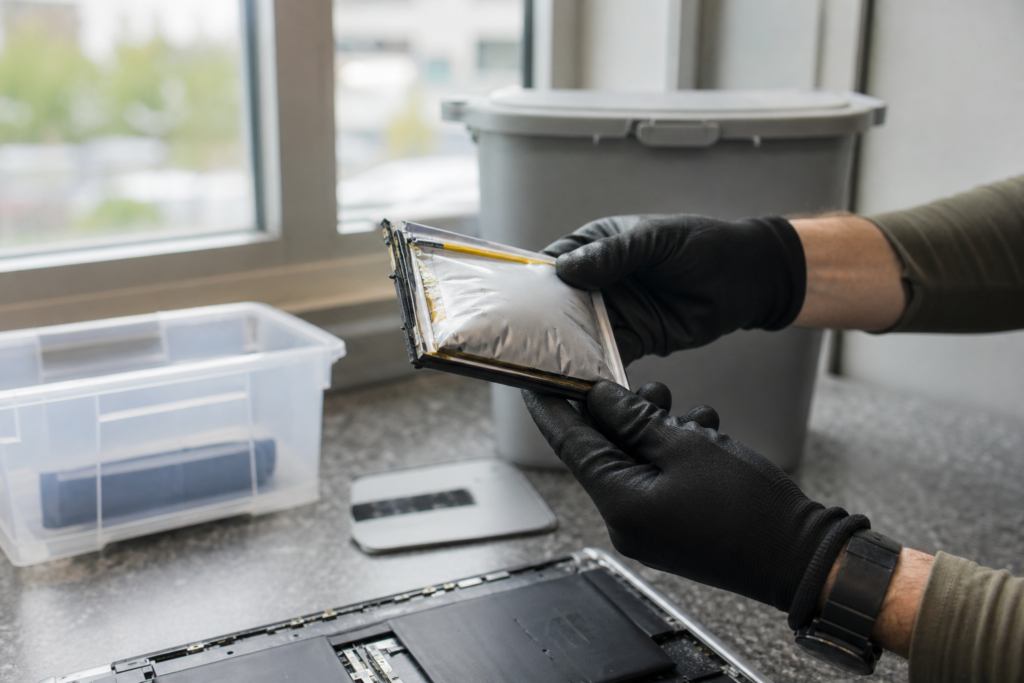
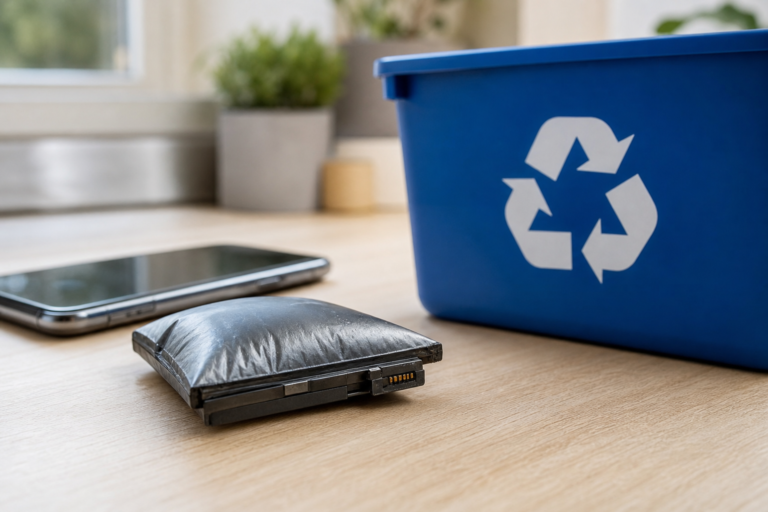
A swollen, dented, leaking, burned, or unusually hot lithium-ion battery should be treated as damaged and potentially hazardous. The safest first step is to stop using it immediately. Do not charge it, test it, puncture it, press on the swelling, or try to repair the battery yourself.
Health Canada lists swelling, dents, torn plastic wrapping, and other visible damage as reasons not to use a lithium-ion battery. These batteries can develop an internal short circuit, overheat, catch fire, or explode. They are common in phones, laptops, power banks, power tools, e-bikes, scooters, toys, and mobility devices.
If the battery is smoking, hissing, sparking, giving off a strong or unusual smell, rapidly getting hotter, or already burning, do not handle it. Move people and pets away if you can do so without passing close to the battery, leave the area, and call 911. Do not put yourself at risk trying to carry a burning battery outside.
Call 911 for an immediate battery fire emergency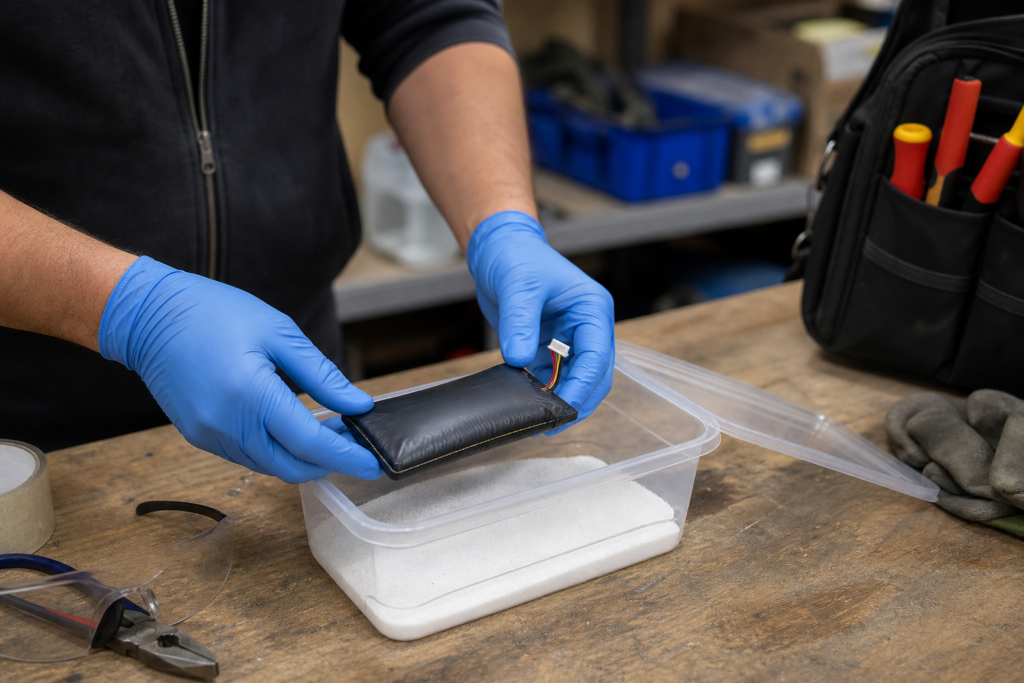
If there is no immediate sign of fire and you can handle the situation without forcing or damaging the battery, place the device or removable battery in a cool, dry location away from paper, bedding, clothing, gasoline, propane, and other flammable materials. A non-combustible area such as a concrete floor is preferable. Keep children and pets away.
Do not store a damaged battery in a vehicle, on a balcony in direct sun, beside a furnace, or near an exit route. Do not put it in a freezer or refrigerator. Avoid moving it more than necessary, especially if the battery is leaking, cracked, badly swollen, or physically crushed.
For temporary storage, Call2Recycle Canada advises using non-flammable material such as sand or kitty litter while you arrange a safe drop-off. That is temporary risk reduction, not a method for making the battery safe to recycle in an ordinary collection box.
Phones, tablets, laptops, e-cigarettes, some power stations, and many e-bikes have batteries that are not designed for consumer removal. Do not pry open the case or use a screwdriver to reach a swollen pack. A puncture or short circuit can trigger a fire.
Keep the device intact and contact the manufacturer, retailer, authorized repair service, or your municipal waste facility for instructions. Tell them clearly that the device contains a swollen or damaged lithium-ion battery.
Canada does not have one universal consumer drop-off rule for every damaged battery. Health Canada says batteries are hazardous waste and directs households to check with their municipality. The correct destination may be a municipal household hazardous-waste depot, a special damaged-battery program, or a designated facility that can arrange a Call2Recycle damaged, defective, and recalled battery kit.
Do not assume that a nearby store accepting ordinary rechargeable batteries can accept a swollen battery. Regular collection boxes are not designed for damaged lithium-ion batteries. Call the location before travelling and describe the condition, chemistry, size, and whether the battery is inside a device.
Recycle Your Batteries, Canada provides a postal-code locator for regular battery and battery-powered-product drop-off options. Its instructions specifically say that damaged, defective, or recalled batteries should be handled through a local municipal waste depot so safe drop-off can be arranged. Select facilities may have the special packaging required for damaged lithium-ion batteries.
If you cannot identify the chemistry or find a suitable municipal contact, Call2Recycle Canada lists customer support at 1-888-224-9764. Ask whether the battery requires damaged, defective, and recalled battery handling before transporting it.
Household garbage and recycling systems can compact, crush, or otherwise damage batteries. A battery that seems inactive can still contain enough energy to start a fire in a garbage truck, transfer station, landfill, or recycling facility.
This is the distinction that causes the most confusion: a used battery is not automatically a damaged battery.
| Battery condition | Typical next step | Important caution |
|---|---|---|
| Used but intact lithium-ion battery | Use a participating battery-recycling or household hazardous-waste site. | Follow the site’s instructions for terminal protection and accepted battery types. |
| Swollen, leaking, dented, burned, or cracked lithium-ion battery | Contact the municipality or a damaged-battery program before drop-off. | Do not use a standard collection box. |
| Battery inside a damaged device | Contact the manufacturer, retailer, repair provider, or municipal waste facility. | Do not remove an embedded battery yourself. |
| Recalled battery or device | Check the recall notice and follow the manufacturer’s specific instructions. | Some recalled batteries have no visible damage. |
For an intact removable battery, a collection site may ask you to protect the terminals with non-metallic tape or place the battery in an individual bag. Do not apply those ordinary recycling steps to a battery that is swollen, leaking, burned, or otherwise damaged unless the receiving program gives you specific instructions.
A damaged battery may be defective, but it may also be part of a product recall. Recalled batteries are identified by details such as the brand, model, serial number, production batch, or lot code. A recall can include batteries that look normal, so visible damage is not the only warning sign.
Have the product name, model number, serial number, and purchase information ready. Check the manufacturer’s safety or recall page and Health Canada’s recalls and safety alerts database. If the product is recalled, follow the recall instructions instead of sending it through ordinary recycling.
Larger battery packs deserve extra caution because they contain more cells and more stored energy. This includes e-bike and scooter batteries, mobility-device packs, lawn-equipment batteries, large power-tool packs, and home energy-storage systems.
Do not carry a swollen or damaged large battery on public transit, take it on an airplane, or put it in checked baggage. Transport Canada says damaged or defective lithium batteries can be dangerous to transport and may be prohibited from air transport. Ask the manufacturer or municipal facility about collection arrangements before moving the pack.
For an e-bike or scooter with a battery that cannot be safely removed, leave the device unused in a safe location and contact the brand or local waste authority. Do not continue riding it to a recycling site.
The safest disposal plan depends on the battery’s condition, size, chemistry, and your municipality’s facilities. When in doubt, pause and ask before moving it.
A. No. Health Canada says lithium-ion batteries should not go in household garbage, and damaged lithium-ion batteries require special handling. Contact your municipality or a designated damaged-battery program before moving the battery.
A. Call2Recycle Canada advises temporarily storing a damaged battery in non-flammable material such as sand or kitty litter while arranging safe drop-off. This is not a substitute for municipal or damaged-battery disposal instructions, and you should not handle a battery that is smoking, hissing, rapidly heating, or burning.
A. Not without confirming first. Regular collection boxes are generally intended for intact batteries. A swollen battery or a device containing one may require a special damaged-battery container or municipal hazardous-waste arrangement.
A. Do not pry it out unless the manufacturer specifically designed it for safe consumer removal and provides instructions. Stop using and charging the device, keep it away from flammable materials, and contact the manufacturer, retailer, repair provider, or municipal waste facility.