Welcome to KnowHow Daily!
Practical guides, money-saving tips, tech solutions, government benefits, and useful information for everyday life.
Welcome to KnowHow Daily!
Practical guides, money-saving tips, tech solutions, government benefits, and useful information for everyday life.

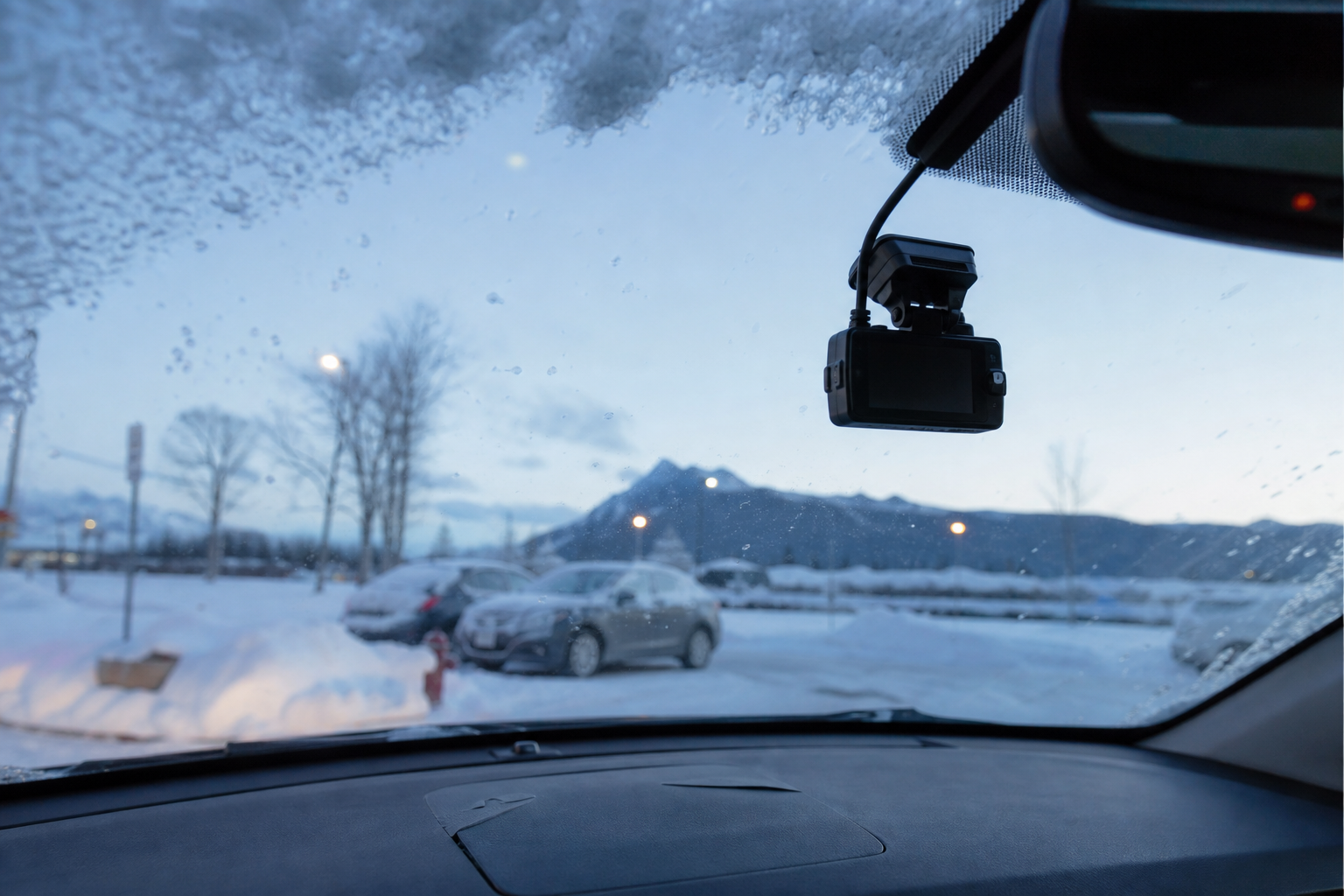
Learn how supercapacitors, parking mode, low-voltage cutoff, and cold-temperature ratings affect dash cam performance in Canadian and U.S. winters.
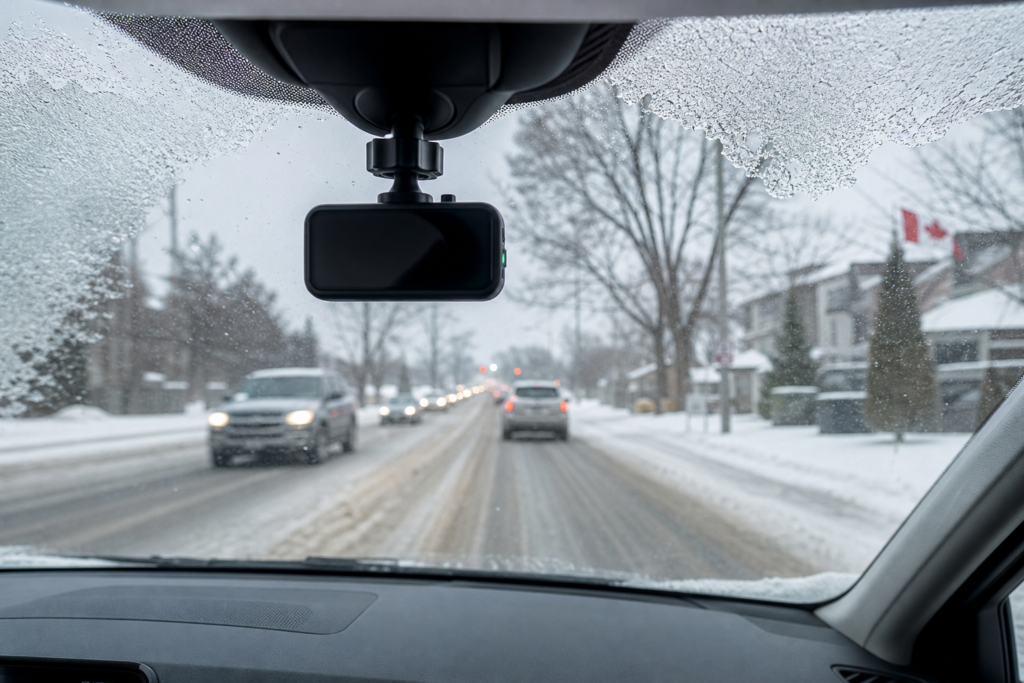
The best dash cam for a Canadian winter is not simply the one with the highest video resolution. It should combine a suitable cold-temperature rating, a supercapacitor instead of a conventional rechargeable battery, dependable power management, and a parking mode that matches how long your vehicle sits outside.
The most important distinction is this: a supercapacitor improves durability and safe shutdown, but it does not make a dash cam immune to cold. You still need to check the manufacturer’s operating-temperature specification for the exact model.
Many dash cams are designed for both hot summer interiors and freezing winter conditions. However, published ratings differ significantly. For example, BlackVue lists an operating range of -20°C to 70°C for some models, while Thinkware lists -10°C to 60°C for certain products. Those numbers are useful comparison points, but they are not a promise that every feature will perform identically at the bottom of the range.
In Canada and the northern United States, look at the complete temperature range rather than assuming that a familiar brand or a 4K label means winter-ready hardware.
A dash cam’s internal backup component is usually there to finish saving the current video when external power is interrupted. It is not normally intended to run the camera for hours after you turn off the vehicle.
A conventional lithium-ion battery can be vulnerable to the repeated heat and cold cycles found inside a parked vehicle. Manufacturers including Thinkware and VIOFO use supercapacitors because they are designed for a wider automotive temperature environment and can provide enough reserve power for a controlled shutdown.
That makes a supercapacitor especially useful after a collision, when power may be interrupted or the camera’s main cable may be damaged. The camera can have a better chance of closing the file properly instead of leaving a corrupted recording.
There is an important limitation, though: supercapacitor does not mean cold-proof. A model rated to -10°C may not be the right choice for a vehicle regularly exposed to -25°C or -30°C conditions. The rating is still the deciding specification.
Cold can affect more than the camera itself. The vehicle battery also loses available capacity as temperatures fall, and an older battery may be affected more severely than a newer one. A parking-mode system that works reliably in mild weather may shut down sooner during a cold snap.
Cold starts can also expose weaknesses in the power connection. Loose wiring, a marginal fuse-tap installation, or a low-quality USB adapter may cause intermittent restarts that look like a camera fault but are actually power-delivery problems.
Some cameras may also take longer to start or may temporarily limit functions until the vehicle interior warms. That is why a published rating should be treated as a baseline for selection, not as a guarantee of identical performance at every temperature and battery condition.
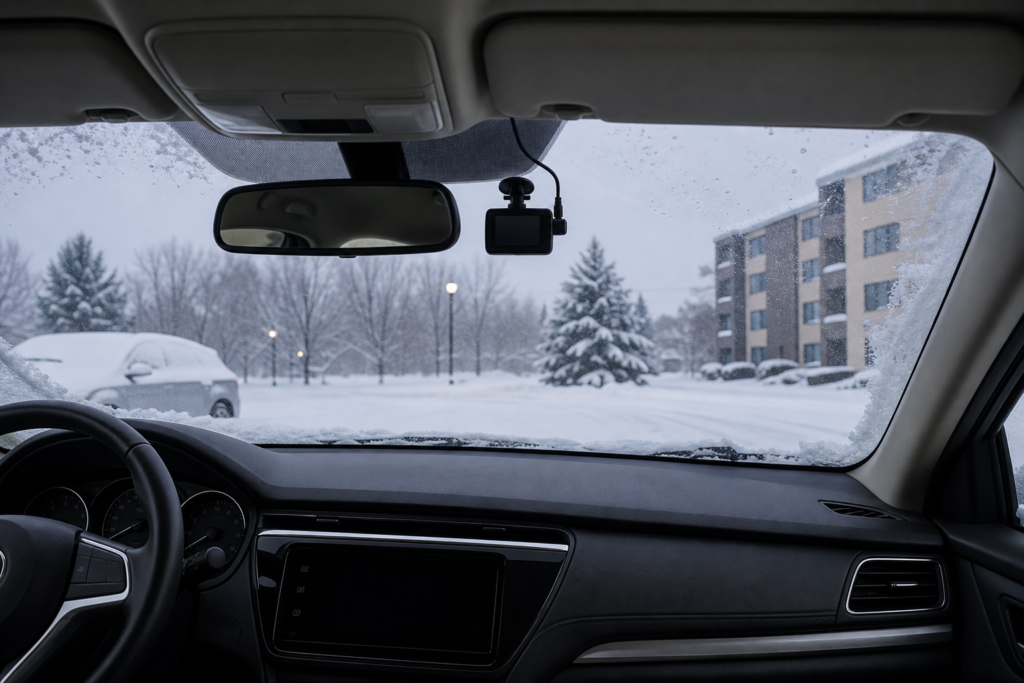
Parking mode lets a dash cam monitor the vehicle after the ignition is switched off. Depending on the model, it may detect impacts, motion, or both; record time-lapse footage; or remain in a low-power standby state until an event occurs.
The camera needs a continuous power source for this to work. A standard accessory outlet that turns off with the ignition usually supports driving recording only. Parking mode commonly requires a hardwire kit, an always-on outlet, an OBD power adapter, or a separate dash cam battery pack.
View official dash cam parking-mode guidanceFor winter use, the power accessory is just as important as the camera. Choose a system with adjustable monitoring time and a low-voltage cutoff. This helps reduce the chance of draining the vehicle battery, although no cutoff can compensate for a weak, aging, or severely cold battery.
Garmin notes that battery age and temperature can reduce available capacity during Parking Guard or Parking Mode use. The company also recommends experienced installation for hardwire cables because incorrect connections can damage the vehicle or create a safety risk.
| Parking mode | How it works | Winter trade-off |
|---|---|---|
| Impact detection | Wakes or records when the camera senses a collision or disturbance. | Uses less power, which is helpful when cold reduces battery capacity. |
| Motion detection | Records movement near the vehicle, sometimes continuously monitoring the scene. | Can use more power and may create unnecessary clips in busy areas. |
| Time-lapse | Records at a reduced frame rate while the vehicle is parked. | Provides longer coverage but may miss details between frames. |
| Energy-saving standby | Stays mostly inactive and wakes for selected events. | Often a sensible choice for long winter parking periods. |
If your vehicle is parked outside overnight in severe cold, impact-only or energy-saving parking mode is generally a more conservative choice than continuous motion recording. The right setting still depends on the camera, hardwire kit, battery condition, and the level of coverage you need.
Do not compare only the lowest number in a product listing. Check whether the number refers to operation or storage, whether it applies to the front camera only, and whether the manufacturer publishes a separate rating for the power adapter, rear camera, or battery pack.
A practical buying rule is to select a model whose operating minimum is below the coldest conditions you realistically expect. If your vehicle regularly sits outside at -25°C, a camera rated only to -10°C gives you little margin. A model rated to -20°C is a closer fit, but you should still expect the vehicle battery and installation to influence real-world performance.
Also look for automatic thermal protection. Thinkware describes systems that can reduce parking-mode functions or shut down when temperatures become unsafe, while other manufacturers specify automatic cutoff or restart behaviour. Protective shutdown is preferable to forcing a camera to operate outside its design range.
The memory card is easy to overlook because it is not part of the temperature headline. Yet dash cams write data continuously, and a poor-quality or unsuitable card can produce recording errors in any season.
Use the card type and capacity recommended for the exact camera. High-end cameras often require high-endurance microSD cards, especially when parking mode is active. Format the card according to the manufacturer’s instructions and replace it when the camera reports errors or recordings become unreliable.
Winter condensation is another reason to avoid moving a very cold camera immediately into a warm, humid environment. Let the device warm gradually before handling it or disconnecting components, and keep the windshield area in front of the lens clear of frost, snow, and road salt film.
Prioritize a supercapacitor, an operating rating below your usual winter low, impact-based parking mode, and a hardwire kit with low-voltage protection. A front camera may be simpler and less power-hungry than a two-channel system.
Give more attention to low-light performance, windshield coverage, lens quality, and a stable mount. A wide temperature range is still valuable, but parking mode may matter less if the vehicle is rarely left unattended for long periods.
Consider a dedicated dash cam battery pack or disable parking mode during extended storage. Even a well-designed low-voltage cutoff cannot guarantee that the vehicle will start after several cold days if the battery is already weak.
The best winter setup is the one with enough temperature margin, conservative power settings, and a reliable installation. Resolution matters, but it should come after those fundamentals.
A. Yes. A supercapacitor is more suitable for automotive temperature swings than many conventional batteries, but the camera still has a specified operating range. If the interior temperature falls below that range, the camera may start slowly, reduce features, shut down, or fail to record until it warms.
A. It can use enough power to matter, especially with an older battery, very cold weather, multiple cameras, Wi-Fi, or continuous motion recording. Low-voltage cutoff reduces the risk but does not eliminate it. Use a shorter monitoring period or a dedicated dash cam battery pack if the vehicle sits for long periods.
A. For a camera mounted in a vehicle, a supercapacitor is usually the more practical internal backup design because it is intended to save footage and shut down rather than provide extended recording. A separate, purpose-built dash cam battery pack is different: it is designed to power parking mode for longer periods and should be evaluated for its own temperature rating.
A. Usually not if the model’s operating rating covers the expected temperature and the installation is reliable. Removing it may be sensible when temperatures are forecast to fall well below the rating, when the vehicle will be stored for an extended period, or when the camera has shown repeated cold-related shutdowns.
A. Higher resolution can increase processing, heat, storage, and power demands, although the effect varies by model. In severe conditions, stable power, a suitable memory card, and an operating temperature rating are more important than choosing the highest available resolution.