Welcome to KnowHow Daily!
Practical guides, money-saving tips, tech solutions, government benefits, and useful information for everyday life.
Welcome to KnowHow Daily!
Practical guides, money-saving tips, tech solutions, government benefits, and useful information for everyday life.

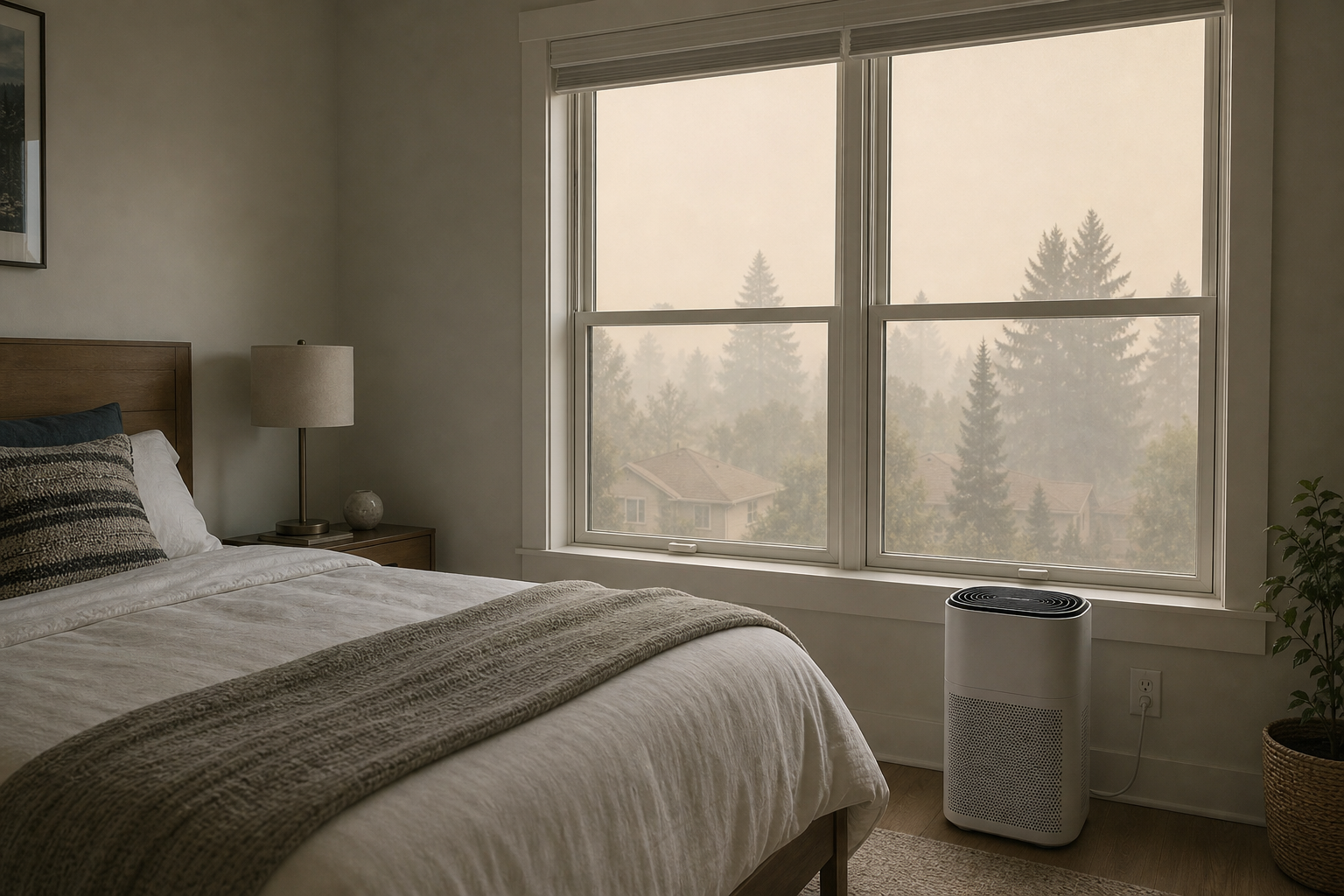
Learn how to choose a portable air cleaner for wildfire smoke using CADR, room size, HEPA filtration, ozone safety, HVAC filters, and practical maintenance tips.
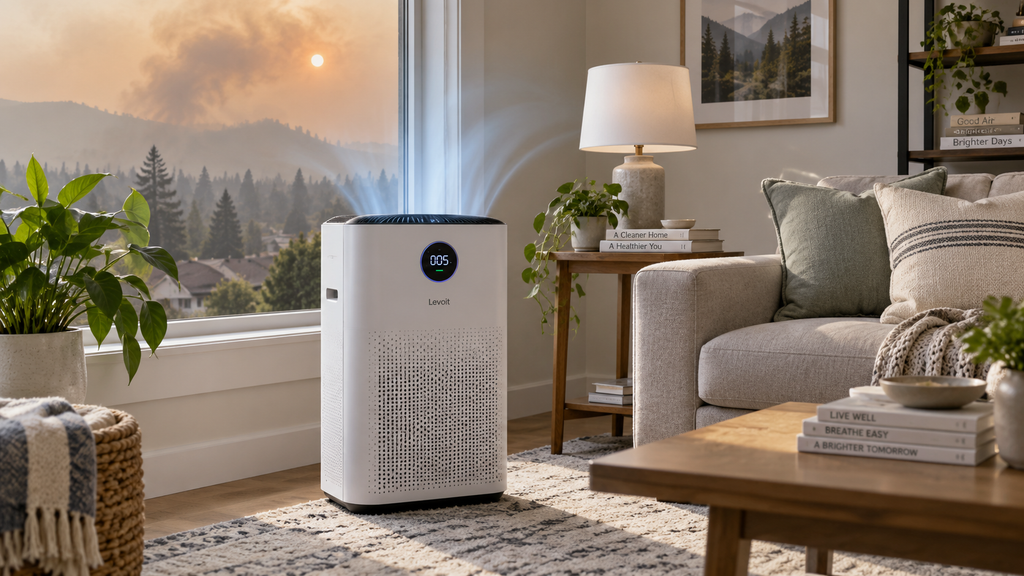
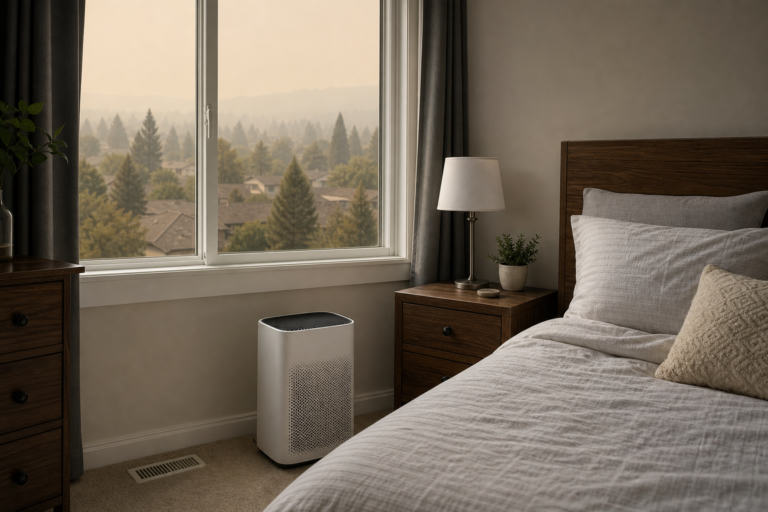
The best portable air cleaner for wildfire smoke is not necessarily the one with the most marketing features. Start with three practical questions: how large is the room, how much filtered air can the unit deliver, and does it avoid producing ozone?
Wildfire smoke contains fine particles, including PM2.5, that can travel deep into the lungs. A portable air cleaner can reduce those particles in one room, but it does not remove smoke from the entire home unless the home has an appropriately designed whole-house system or multiple strategically placed units.
The most useful specification is the clean air delivery rate, or CADR. For smoke, look for the tobacco-smoke CADR rather than relying only on a vague room-size claim. As a general EPA guideline, the smoke CADR should be at least two-thirds of the room’s area in square feet. A 150-square-foot room, for example, calls for a smoke CADR of about 100 cfm or higher.
Measure the room’s length and width, then multiply those numbers to get square footage. Most published room ratings assume an 8-foot ceiling, so choose a larger unit if the ceiling is substantially higher or if the space connects openly to other rooms.
| Room area | Approximate minimum smoke CADR | Practical buying approach |
|---|---|---|
| 100 sq. ft. | About 67 cfm | A small bedroom or office unit may be enough |
| 200 sq. ft. | About 133 cfm | Choose a medium unit, preferably with extra capacity |
| 300 sq. ft. | About 200 cfm | Look for a larger unit or use two smaller units |
| 500 sq. ft. | About 333 cfm | Consider a high-CADR unit or multiple cleaners |
These figures are a starting point, not a guarantee of a particular indoor particle level. Open floor plans, high ceilings, frequent door opening, cooking, and smoke entering through leaks can all increase the cleaning workload. Buying some extra CADR is usually more useful than choosing a unit that only barely meets the minimum.
Two smaller units can also make sense. One in a bedroom and another in the main living area may provide better coverage than one oversized machine placed in a hallway.
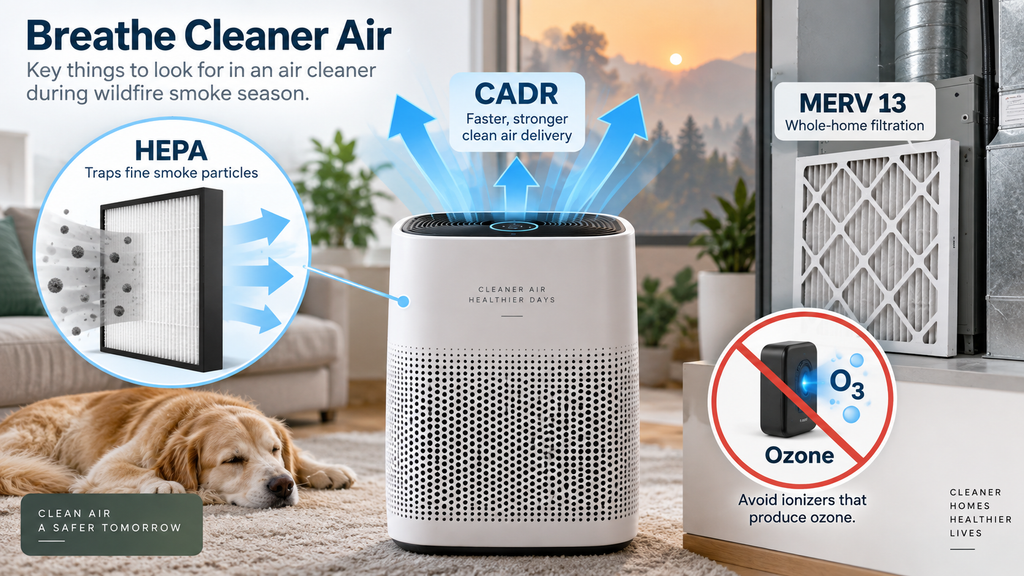
For smoke particles, the basic goal is physical filtration. A HEPA filter is one way to achieve highly efficient particle removal, but the word “HEPA” alone does not tell you how quickly a machine cleans a room. A compact HEPA unit with a weak fan may deliver less clean air than a larger mechanical unit with a higher verified CADR.
That is why CADR and filter technology should be considered together. Look for a unit that combines a meaningful smoke CADR with a particle filter. An activated-carbon layer can help with some odors and gases, but thin carbon sheets usually have limited capacity for heavy smoke odors. Don’t buy a small carbon pad expecting it to solve every smoke-related smell.
Noise is another real trade-off. A unit may advertise a high CADR on its highest setting but be used mostly on a quieter, lower setting. Check the noise rating if available, and consider whether you’ll run it overnight. A slightly larger unit can be useful because it may clean effectively without needing to operate at full speed all the time.
Avoid air cleaners that intentionally generate ozone. Ozone is a lung irritant, and it is not a safe substitute for particle filtration in an occupied home. Be especially cautious with products marketed as ozone generators, ionizers, or odor eliminators that make broad claims without clearly explaining their filtration performance.
In the United States, California’s Air Resources Board maintains a list of certified air-cleaning devices. CARB certification is useful as a low-ozone and electrical-safety check, but it does not rate how effective a model is at removing wildfire smoke. A mechanical-filtration unit that does not use ionization or ozone-generating technology is often the simplest choice.
Search California’s certified air-cleaning devices
Canadian shoppers should apply the same basic principle: choose a certified portable air cleaner designed to filter fine particles and avoid ozone-generating devices. Health Canada specifically warns against using ozone generators in homes.
Each option solves a slightly different problem.
| Option | Best fit | Main advantage | Main limitation |
|---|---|---|---|
| Portable air cleaner | One bedroom, office, or living space | Simple, standardized, and easy to move | Usually cleans only one room |
| Central HVAC filter | Homes with forced-air heating or cooling | Can filter air across more of the home | Must be compatible with the system; airflow may be affected |
| DIY box-fan cleaner | Short-term emergency use or limited budgets | Can be inexpensive and effective when well built | Performance and safety depend on the design and fan |
If you have forced-air HVAC, ask the manufacturer or an HVAC professional whether the system can handle a MERV 13 filter. A higher-efficiency filter is not automatically appropriate for every furnace or air conditioner. Once installed, running the fan continuously or using the system’s recirculate setting can increase filtration, but it may also increase energy use.
A DIY cleaner made with a newer box fan and MERV 13 filter can be a useful temporary alternative when commercial units are unavailable or unaffordable. EPA recommends using a fan made in 2012 or later with a UL or ETL safety mark. Keep the fan clear of curtains and furniture, don’t use a damaged fan or extension cord, and replace the filter when it becomes dirty. Older fans should not be left unattended or used while sleeping.
Put the unit in the room where people spend the most time, especially a bedroom or designated cleaner-air room. Follow the manufacturer’s clearance instructions, and avoid placing the intake or exhaust directly against a wall, curtain, or large piece of furniture.
During heavy smoke, run the cleaner continuously if practical. Use a higher fan setting when smoke is at its worst, then reduce the speed if noise or comfort becomes a problem. Keep windows and doors closed as much as possible, and avoid adding indoor pollution from candles, smoking, frying, or unnecessary exhaust-fan use.
Check the filter regularly. Wildfire smoke can load a filter much faster than ordinary household dust. Replace it when it looks heavily soiled, airflow drops, or the manufacturer’s instructions call for a change. Keeping one spare filter on hand is a simple preparation step that can prevent a last-minute shortage.
Use your local official air-quality information to decide when to close windows, reduce outdoor activity, and run filtration more consistently. In the United States, the AirNow Fire and Smoke Map reports fine-particle pollution, smoke plumes, and related recommendations. In Canada, use the federal Air Quality Health Index for local forecasts.
View the official U.S. AirNow Fire and Smoke Map View the official Canadian Air Quality Health Index
A. Not automatically. A HEPA filter can capture fine particles, but the unit also needs enough airflow. Compare the smoke CADR, room size, noise, and replacement-filter availability rather than choosing based on the HEPA label alone.
A. That is often sensible during wildfire smoke events. Extra capacity can help the unit clean faster or run at a quieter speed, especially in rooms with high ceilings, open doorways, or frequent air leakage.
A. Only if the HVAC manufacturer or a qualified professional confirms that the system can handle it. A filter that is too restrictive may reduce airflow or place extra strain on the equipment.
A. They can be a short-term option when properly assembled, but safety depends on the fan, filter, setup, and maintenance. Use a newer fan with a UL or ETL safety mark, keep it unobstructed, follow the manufacturer’s instructions, and replace dirty filters promptly.