Welcome to KnowHow Daily!
Practical guides, money-saving tips, tech solutions, government benefits, and useful information for everyday life.
Welcome to KnowHow Daily!
Practical guides, money-saving tips, tech solutions, government benefits, and useful information for everyday life.

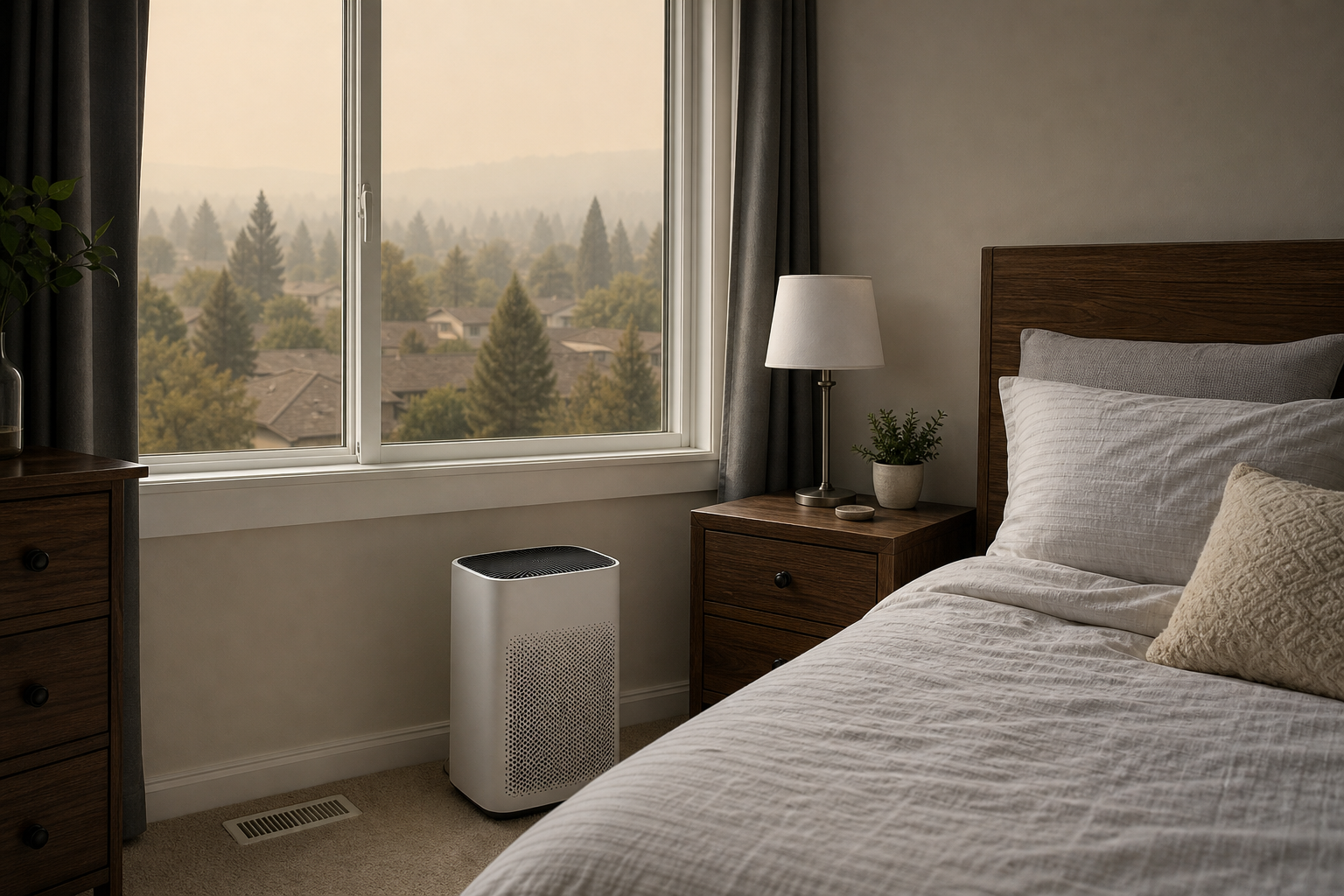
Learn how to choose an air purifier for wildfire smoke, allergies, and small rooms using CADR, HEPA filtration, noise, ozone safety, and filter costs.
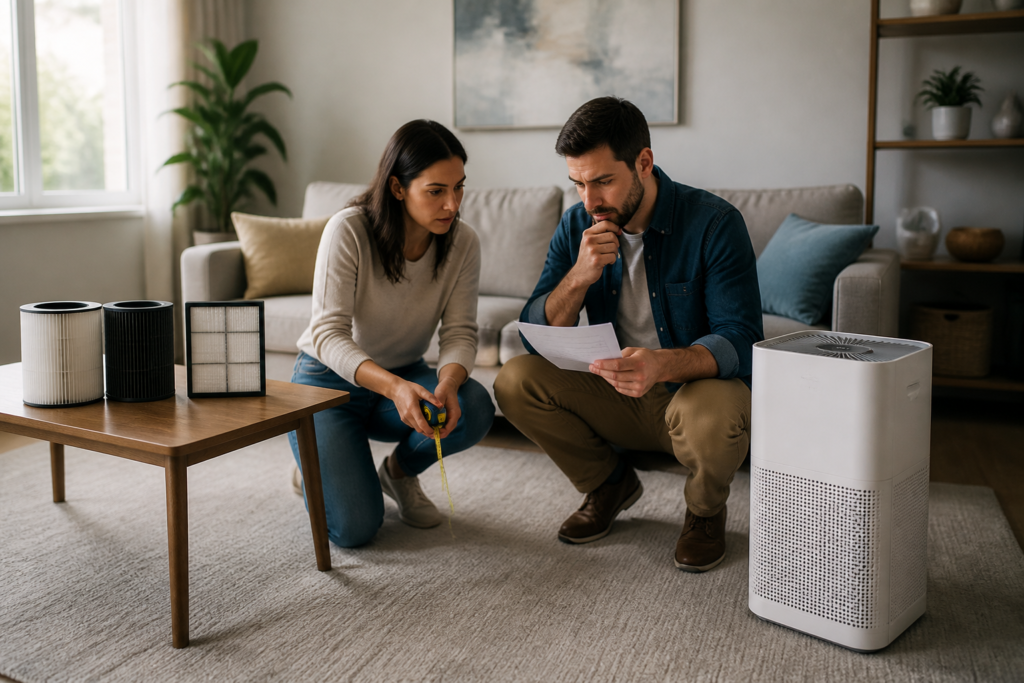
The best air purifier is not necessarily the one with the most features. For wildfire smoke, pollen, dust, and other airborne particles, the specifications that matter most are the unit’s clean air delivery rate, or CADR, its filtration method, its ozone emissions, and the cost of replacement filters.
Start by measuring the room where the purifier will run. Then choose a model with a smoke CADR appropriate for that space. If the room is larger than the purifier’s recommended area, use a larger unit or more than one purifier rather than expecting a small device to clean the whole home.
The key distinction is simple: HEPA describes filtration efficiency, while CADR describes how quickly the machine delivers filtered air. A purifier can have a HEPA filter but still be too small for the room.
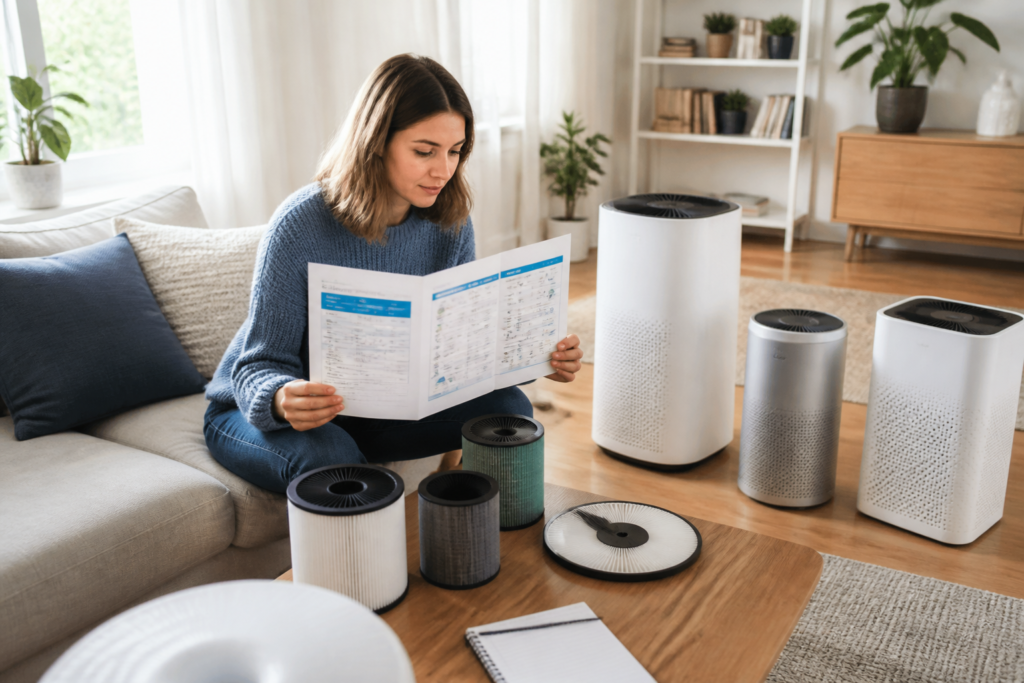
CADR stands for clean air delivery rate. It measures how much filtered air a purifier can deliver, usually at its highest fan speed. Higher CADR generally means faster particle removal and coverage of a larger space.
For an average room with an 8-foot ceiling, the EPA’s approximate minimum CADR guide is:
| Room area | Approximate minimum CADR | Practical example |
|---|---|---|
| 100 square feet | 65 cfm | Small bedroom or home office |
| 200 square feet | 130 cfm | Large bedroom or compact living room |
| 300 square feet | 195 cfm | Open bedroom and office area |
| 400 square feet | 260 cfm | Medium living room |
| 500 square feet | 325 cfm | Large living room or studio apartment |
| 600 square feet | 390 cfm | Large open-plan area |
These figures are estimates, not a guarantee of a particular indoor air quality result. Higher ceilings increase the volume of air, and open floor plans may require more airflow than a product’s marketing coverage suggests. For wildfire smoke, a useful EPA rule of thumb is to choose a smoke CADR equal to at least two-thirds of the room’s square footage. For a 300-square-foot room, that works out to roughly 200 cfm.
When comparing models, look specifically for the smoke CADR. Smoke represents smaller particles than dust or pollen, making it the more useful rating for wildfire smoke and fine particulate matter.
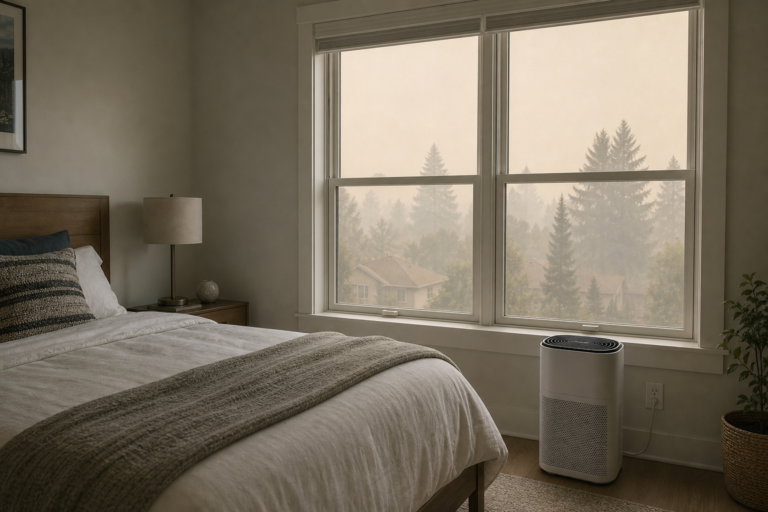
A purifier for a small bedroom does not need to be enormous, but it should have enough airflow to clean the room without requiring maximum speed all night. A unit with more capacity than the bare minimum can often run at a lower, quieter setting while still moving a useful amount of air.
For a 100- to 200-square-foot bedroom, look for:
Place the purifier where air can move freely around it. Keep it away from curtains, furniture, walls, and other objects that block the intake or exhaust. If you are using it during a smoke event, closing windows and doors is also important; a purifier cannot compensate fully for a steady flow of smoky outdoor air into the room.
Wildfire smoke and household allergens overlap, but they are not exactly the same shopping problem.
For wildfire smoke, focus on high smoke CADR, reliable particle filtration, low or zero ozone emissions, and the ability to run continuously. Fine smoke particles can load a filter faster than ordinary household dust, so inspect the filter more often during a smoke event.
For allergies, a properly sized particle purifier can help reduce airborne pollen, dust, and some other particles. It will not remove allergens that have already settled into carpets, bedding, or upholstery unless those particles become airborne again. Regular cleaning and source control still matter.
If odors or gases are a major concern, look for an activated carbon filter. CADR does not measure gas removal, and a thin carbon sheet may do little for persistent odors. More carbon generally provides more adsorption capacity, but manufacturers do not have a single widely used gas-removal rating that makes comparisons as straightforward as CADR.
A HEPA filter is a type of mechanical filter designed to capture very small airborne particles. It is useful, but the word HEPA alone does not tell you whether the purifier is powerful enough for your room.
Ionizers, electrostatic features, plasma systems, ozone generators, and some other electronic technologies deserve more scrutiny. They may be marketed as advanced air cleaning, but some can produce ozone, which irritates the lungs. The EPA does not recommend ozone-generating air cleaners for home use, and California’s Air Resources Board warns against unlisted ozone generators.
For the simplest choice, select a purifier that relies primarily on mechanical filtration. If a model includes an ionizer or another electronic feature, check whether it can be turned off and whether the specific model is listed in the California Air Resources Board’s certified database. CARB certification addresses electrical safety and ozone limits; it does not prove that the device has excellent particle-removal performance.
A purifier only helps while it is running. That makes noise and maintenance practical performance issues, not minor extras.
Noise ratings are usually measured at a particular fan speed, often the highest setting. A model may be quiet in sleep mode but much louder when it is working hard. If you plan to use it in a bedroom, compare the published noise level at the settings you are likely to use rather than relying on a vague “quiet” claim.
Before buying, check:
Useful features include a genuine filter-change indicator, a physical control panel, a timer, and an airflow design that does not blow directly across your bed or desk. Wi-Fi, air-quality displays, and automatic modes can be convenient, but they should not outweigh weak CADR, high noise, or expensive filters.
For an open floor plan, measure the entire connected area you expect the purifier to serve. A unit designed for a closed 200-square-foot bedroom may struggle in a 600-square-foot living area, even if the manufacturer lists an optimistic maximum coverage number.
Two smaller purifiers can sometimes be more practical than one large unit, particularly when rooms are separated by walls or doors. Place one in the room where people spend the most time and another near a bedroom or other priority area.
If you have central heating or air conditioning, the HVAC filter is another part of the strategy. The EPA recommends using a MERV 13 filter, or the highest-efficiency filter your system can safely accommodate, and consulting the equipment manufacturer or an HVAC professional when necessary. A central system only filters air while the fan is operating, while a portable purifier can provide targeted filtration in one room.
If you want one simple decision rule, choose the quietest mechanical-filter purifier you can afford that has enough smoke CADR for the room and replacement filters you can realistically keep buying. That combination is more useful than a long list of smart features or an impressive coverage number without a matching CADR.
A. Not necessarily. A larger unit can provide more airflow, but it may cost more, take up more space, or use more electricity. The better choice is a purifier with enough smoke CADR for the room that can run comfortably and consistently.
A. Particle filters capture much of the fine particulate matter in smoke, but odors are gases and require activated carbon or another gas-adsorbing filter. A small carbon layer may have limited capacity, so do not assume a purifier with any carbon filter will eliminate strong smoke odor.
A. A properly maintained portable purifier can generally be used continuously, including overnight, when operated according to the manufacturer’s instructions. Use a suitable fan setting, keep the airflow unobstructed, and check the filter more often during heavy smoke conditions.
A. No. CARB certification primarily addresses ozone emissions and electrical-safety requirements. It does not rate a purifier’s particle-removal effectiveness, so you still need to compare CADR, filtration, noise, and filter costs.
A. A well-built DIY air cleaner can reduce particles and may be useful when a commercial unit is unavailable or unaffordable. Its performance depends on the fan, filter, design, and assembly. For routine use, a commercial purifier provides more standardized performance information.