Welcome to KnowHow Daily!
Practical guides, money-saving tips, tech solutions, government benefits, and useful information for everyday life.
Welcome to KnowHow Daily!
Practical guides, money-saving tips, tech solutions, government benefits, and useful information for everyday life.

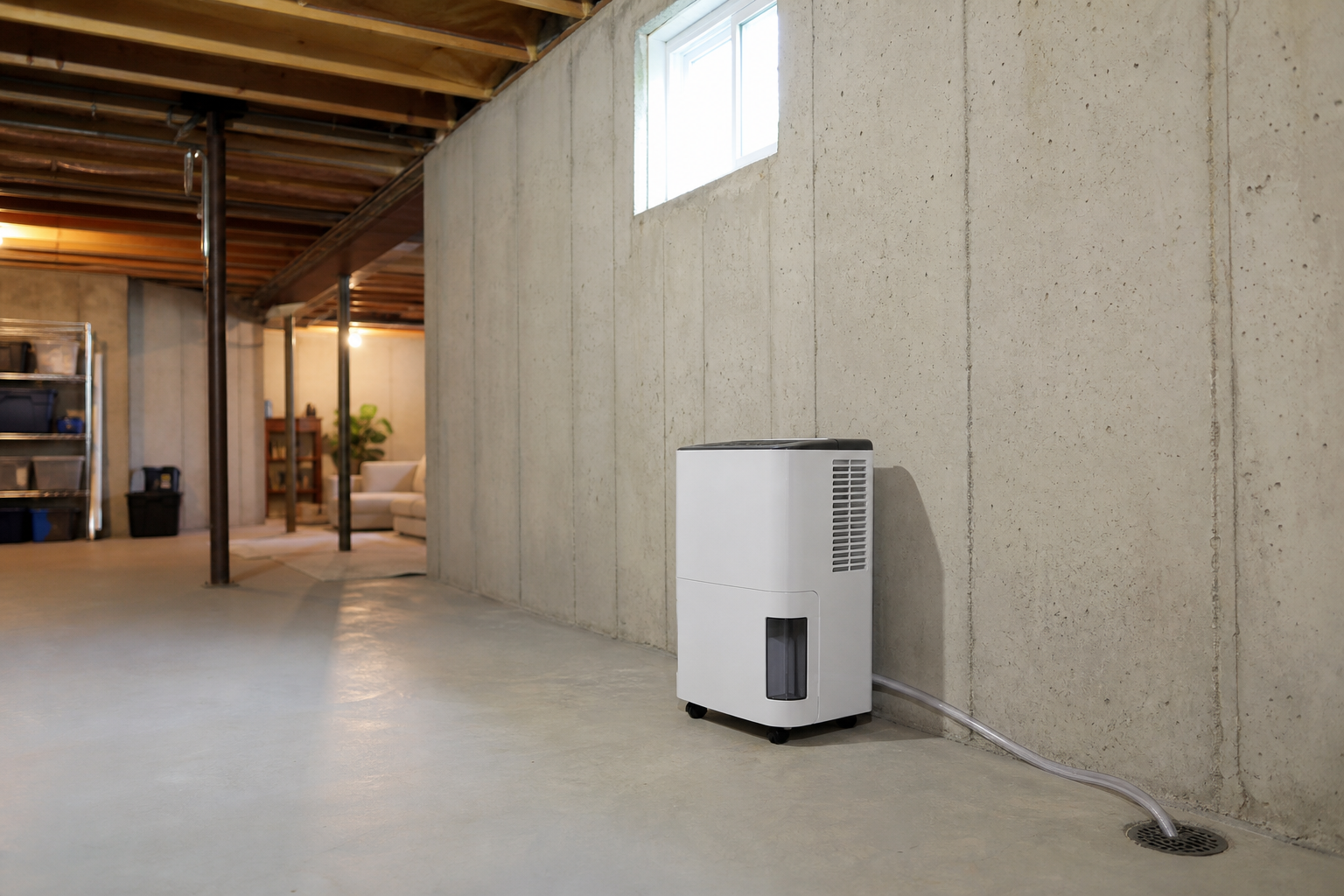
Learn how to choose a basement dehumidifier by capacity, humidity level, cold-temperature performance, drainage, energy efficiency, and portable versus whole-home design.
The right basement dehumidifier depends on two things: the size of the area and how much moisture it has to remove. A 1,000-square-foot basement with a mild musty smell needs less capacity than a smaller space with sweating walls, wet floors, or water entering through the foundation.
For most homes, the practical target is to keep relative humidity around 30% to 50%. In colder climates, you may need a lower setting during winter to reduce condensation on windows, pipes, and foundation surfaces. A small hygrometer is useful because a basement can feel comfortable while still staying humid enough to encourage mold growth.
The most important distinction is between capacity and operating conditions. Capacity is usually listed in pints of water removed per day in the United States and litres per day in Canada. That number is measured under test conditions, so a model with a larger advertised capacity is not automatically the best choice for a cool basement.
Use the following ranges as a starting point, then size up when the basement is unusually damp or the unit will run for long periods.
| Basement condition | What it looks or smells like | Small to medium space under 2,000 sq. ft. | Large space over 2,000 sq. ft. |
|---|---|---|---|
| Slightly to moderately damp | Occasional musty odor or a generally damp feeling; roughly 50%–75% RH | About 20–30 pints per day | 30+ pints per day |
| Very damp | Persistent damp smell, damp spots on walls or floors; roughly 75%–90% RH | About 25–40 pints per day | 40+ pints per day |
| Wet | Sweating walls or floors, seepage, or added moisture from indoor laundry | About 30–50 pints per day | 50+ pints per day |
These are minimum planning ranges rather than guarantees. If you are choosing between two nearby capacities, the larger model is usually the safer choice, especially for an open basement, a space with several rooms, or a home in a humid climate.
Canadian product information may use litres per day instead. As a rough conversion, two pints equal approximately one litre. Natural Resources Canada’s guidance uses similar condition-based ranges, with roughly 10–15 litres per day for a slightly to moderately damp small-to-medium space, 11–20 litres for a very damp space, and 15–25 litres for a wet space.
Many basements are cooler than the rest of the home, particularly in spring, fall, and winter. If the room commonly drops below 65°F (18°C), choose a dehumidifier specified for lower-temperature operation.
Standard compressor dehumidifiers can develop frost on their evaporator coils in cool air. When that happens, the compressor may cycle on and off or spend time defrosting instead of removing moisture. Some models include an anti-frost sensor, but the feature does not make every unit suitable for a cold basement. Check the manufacturer’s stated operating-temperature range rather than relying on the product’s capacity number alone.
In Canada, the same practical warning applies below 18°C. A dehumidifier can be useful during muggy summer weather, but it may be less effective during a cold, dry winter. If humidity remains high year-round, look for the source of the moisture instead of expecting a portable appliance to solve a foundation leak, drainage problem, or ventilation issue.
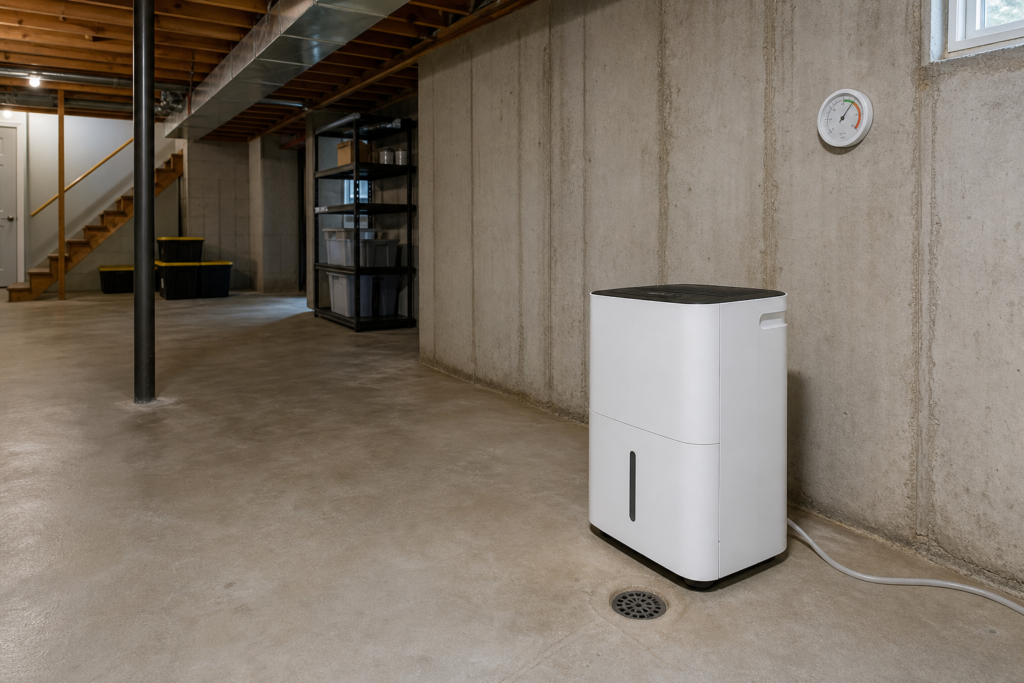
A dehumidifier that shuts off every day because its bucket is full is not doing much for the basement. Before buying, inspect the available drainage options.
Bucket operation is the simplest setup and can work well in a lightly damp basement, seasonal cottage, or rental where permanent changes are not practical. Most portable models shut off automatically when the tank is full. The trade-off is regular emptying, which can become inconvenient during humid weather.
A hose connection can send condensate to a floor drain or sump basin without repeated bucket emptying. The unit generally needs to sit higher than the drain, and the hose must slope continuously downward. Keep the hose away from electrical cords and connections, and follow the manufacturer’s instructions for the correct fitting and hose size.
A pump is useful when the nearest drain is higher than the dehumidifier or too far away for gravity drainage. It adds convenience but also introduces another component that can clog or fail. Check whether the pump is included or sold separately, and confirm the maximum lift and hose length before installation.
For a permanently installed whole-home system, drainage is normally planned as part of the installation. An HVAC professional may route the condensate to a floor drain, plumbing connection, or condensate pump.
A portable unit is usually the better choice when one basement or one problem area needs moisture control. It costs less to install, can be moved, and does not require ductwork. Place it where air can circulate freely, leaving the clearances specified by the manufacturer.
A whole-home dehumidifier is designed to connect to the home’s duct system and treat air from multiple areas. It may make sense when humidity stays above about 55% throughout a relatively well-sealed home with central air conditioning. The system is more expensive and normally requires professional sizing, installation, condensate drainage, and duct adjustments.
| Choose a portable unit when… | Consider whole-home equipment when… |
|---|---|
| Only the basement is damp | Several rooms have persistent humidity |
| You need a lower-cost or movable solution | The home already has suitable central ductwork |
| You can provide bucket or drain-hose access | You want integrated, automatic humidity control |
| The problem is seasonal or localized | A qualified contractor can size and install the system correctly |
Neither type should be used to hide active water intrusion. Fix leaking plumbing, foundation seepage, poor grading, blocked gutters, or downspouts that discharge beside the foundation. A dehumidifier controls airborne moisture; it does not repair the building envelope.
Look for the integrated energy factor, or IEF. It measures litres of water removed per kilowatt-hour of electricity, including relevant operating and standby energy. A higher IEF generally indicates better efficiency, although the most efficient model is not useful if it is too small, cannot operate in the basement’s temperature range, or has no practical drainage option.
ENERGY STAR says certified dehumidifiers use less energy than comparable conventional models. The current U.S. specification took effect on October 1, 2025, and newer capacity ratings may not line up directly with older product labels because the testing approach changed. Compare current models using the same rating system rather than assuming a newer lower pint number means weaker performance.
Canadian shoppers should also check the ENERGY STAR symbol and the available product information from Natural Resources Canada. The IEF is reported in litres per kilowatt-hour in both markets, which makes it more useful for comparing energy performance than capacity alone.
Compare certified dehumidifier models in the ENERGY STAR Product Finder
A. Not necessarily. A 50-pint model may be appropriate for a very damp or wet basement, a large open area, or a space with sweating walls and floors. For a mildly damp small basement, it may cost more than necessary, but oversizing is generally preferable to choosing a unit that cannot keep up.
A. Only if humidity remains high and the model is rated for the basement’s temperature. Compressor units can frost and lose effectiveness in cold conditions. In Canada and other cold climates, winter humidity may instead need to be reduced through ventilation, air sealing, heating, or correction of moisture sources.
A. It can reduce one condition that supports mold by lowering humidity, but it cannot remove existing mold or fix ongoing water intrusion. Visible mold, leaks, condensation, and damp building materials need separate cleaning, repair, or professional assessment.
A. No, but a nearby floor drain makes gravity drainage easier. If the drain is farther away or higher than the unit, you may need a condensate pump. Otherwise, the unit can use its bucket, provided someone empties it regularly.