Welcome to KnowHow Daily!
Practical guides, money-saving tips, tech solutions, government benefits, and useful information for everyday life.
Welcome to KnowHow Daily!
Practical guides, money-saving tips, tech solutions, government benefits, and useful information for everyday life.


Learn why your hands go numb at night, how sleep position and wrist braces may help, what finger patterns can mean, and when to seek medical care.
When your hand “falls asleep,” a nerve is usually being compressed or stretched for a while. Sleeping with your wrist sharply bent, your elbow tightly folded, or your arm underneath your body can put pressure on the nerves that travel from your neck to your hand. Once you change position, the pressure is relieved and the tingling often fades within a few minutes.
Nighttime symptoms can also be a sign of a nerve problem that is more than a temporary sleep-position issue. The most common possibility is carpal tunnel syndrome, in which pressure builds on the median nerve at the wrist. Other possibilities include compression of the ulnar nerve at the elbow, a pinched nerve in the neck, diabetes-related nerve damage, arthritis, or another cause of peripheral neuropathy.
The location and pattern can provide useful clues, although they cannot diagnose the cause by themselves.
| Where you feel it | Possible pattern |
|---|---|
| Thumb, index, middle, and part of the ring finger | Often fits median-nerve irritation, including carpal tunnel syndrome. |
| Little finger and the little-finger side of the ring finger | May fit ulnar-nerve compression, commonly around the elbow. |
| Most of the hand with neck or shoulder pain | May involve a nerve coming from the neck. |
| Both hands and possibly the feet | Can occur with a more widespread nerve problem, such as peripheral neuropathy. |
If the whole hand feels numb after you sleep on it and the sensation quickly disappears after moving, temporary compression is more likely. If the same fingers go numb repeatedly, symptoms last longer, or you notice weakness, the problem deserves a closer look.

Your wrist is most vulnerable when it stays bent for a long time. A curled wrist can narrow the space around the median nerve, which helps explain why carpal tunnel symptoms often worsen at night. Sleeping with your arm under your head or body can also compress nerves higher up the arm.
A tightly bent elbow can irritate the ulnar nerve. Try not to sleep with your elbow folded sharply for hours at a time, and avoid resting your elbow against a hard surface during the evening. A pillow supporting the forearm may make it easier to keep the arm in a relaxed position.
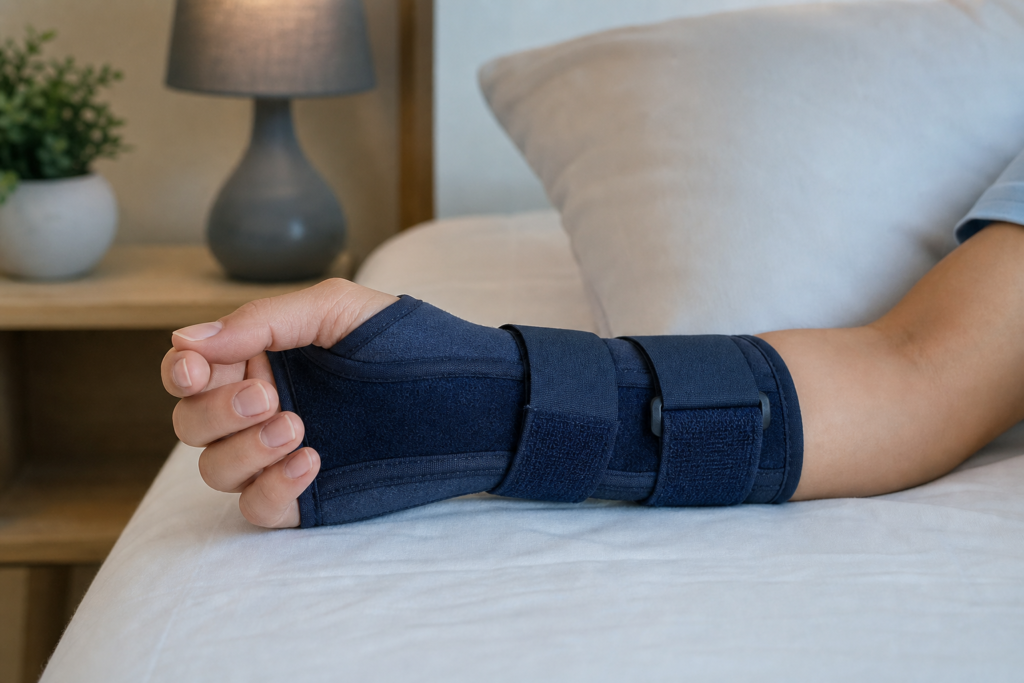
A wrist brace may help when nighttime numbness is related to carpal tunnel syndrome. Its purpose is not to squeeze the wrist; it is to prevent the wrist from folding into positions that increase pressure on the median nerve. A brace that keeps the wrist in a neutral, relatively straight position is generally more useful than one that forces the wrist sharply backward.
Choose a removable night splint that fits comfortably and supports the wrist without making the fingers cold, pale, swollen, or more numb. A metal or firm support along the palm may help limit bending, but the brace should not dig into the skin or create pressure points.
A brace can reduce symptoms, but it does not prove that carpal tunnel syndrome is the cause. If numbness comes from the neck, elbow, diabetes, medication effects, or another condition, a wrist brace may do little or may distract from the underlying problem.
Keep track of which fingers are affected, whether one or both hands are involved, how long the numbness lasts, and whether it occurs during the day. Note any related symptoms such as wrist pain, neck pain, burning, weakness, clumsiness, or dropping objects. This information can help a clinician identify which nerve may be involved.
It is reasonable to book a routine appointment if the numbness keeps returning, has no obvious positional trigger, lasts after you get up, spreads up the arm, or affects your ability to grip. Medical evaluation is also sensible if you have diabetes, thyroid disease, arthritis, a recent injury, pregnancy-related swelling, or symptoms in both hands and the feet.
A clinician may examine sensation, strength, reflexes, the wrist, elbow, neck, and circulation. Depending on the pattern, testing such as nerve-conduction studies, blood tests, or imaging may be considered. Do not start high-dose vitamin supplements or stop prescribed medication on your own just because numbness is present.
Call 911 in the United States or Canada if numbness begins suddenly, especially on one side of the body, or occurs with facial drooping, arm weakness, confusion, trouble speaking, sudden vision changes, severe dizziness, trouble walking, or a sudden severe headache. These can be signs of stroke or another emergency.
Get urgent medical help after a head, neck, or back injury if you have new numbness, weakness, or difficulty moving. Emergency assessment is also appropriate if you lose control of an arm or leg, develop severe symptoms rapidly, or have numbness together with chest pain or serious breathing trouble.
Start by changing the position of your wrist, elbow, and arm for several nights. If the symptoms follow a median-nerve pattern, try a comfortable neutral-position wrist splint at night and reduce activities that involve forceful gripping or prolonged wrist bending. If there is no clear improvement after a reasonable trial, or if weakness or daytime symptoms appear, arrange an appointment rather than continuing to self-treat.
The main distinction is simple: brief numbness that resolves after changing position is often temporary compression, while recurring, persistent, spreading, or weakness-related numbness needs professional evaluation.
A. Sleep keeps your wrist, elbow, shoulder, or neck in one position for a long time, so a nerve may be compressed without you noticing. If the feeling disappears quickly after you move, temporary pressure is more likely. Repeated episodes can still point to carpal tunnel syndrome or another nerve problem.
A. Only use a brace on a hand that needs it, unless a healthcare professional recommends otherwise. If both hands are repeatedly numb, consider getting medical advice rather than assuming both sides have the same cause.
A. It can. Side sleeping may place pressure on the shoulder, arm, elbow, or wrist, particularly if the arm is under your head or body. Supporting the upper arm with a pillow and keeping the wrist relaxed may reduce pressure.
A. No. Carpal tunnel syndrome is one common cause, but numbness can also involve the ulnar nerve at the elbow, a nerve in the neck, peripheral neuropathy, injury, circulation problems, or medication and health conditions. The finger pattern and associated symptoms help guide evaluation.
A. Stop and seek advice if the brace causes worsening numbness, pain, swelling, skin irritation, cold fingers, or colour changes. It should support the wrist without restricting circulation.