Welcome to KnowHow Daily!
Practical guides, money-saving tips, tech solutions, government benefits, and useful information for everyday life.
Welcome to KnowHow Daily!
Practical guides, money-saving tips, tech solutions, government benefits, and useful information for everyday life.

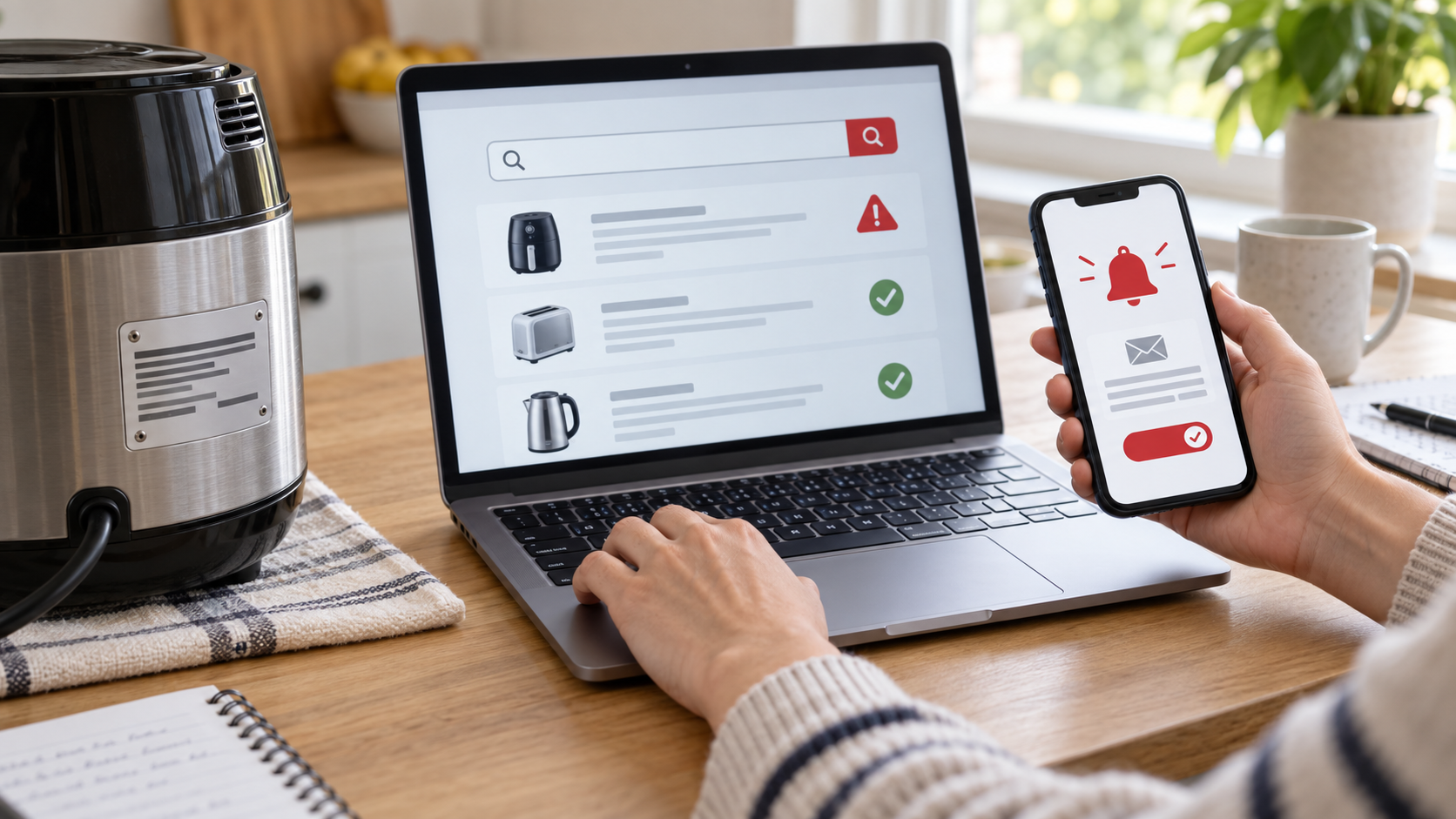
Learn how to search Canada’s official product recall database, verify model numbers, understand recall instructions, and subscribe to safety alert updates.
Canada’s official Recalls and Safety Alerts database is the best starting point for checking whether a product has been recalled or is subject to a safety warning. It brings together notices for consumer products, food, health products, medical devices, cannabis products, and vehicle-related recalls.
The important distinction is that a general product search is not the same as confirming that your exact item is affected. A notice may apply only to certain model numbers, production dates, lot codes, serial-number ranges, sizes, flavours, or Canadian distribution channels.
That matters when you’re buying second-hand, accepting a hand-me-down, listing something for resale, or checking an appliance, charger, toy, cosmetic, baby product, or household item already in your home.
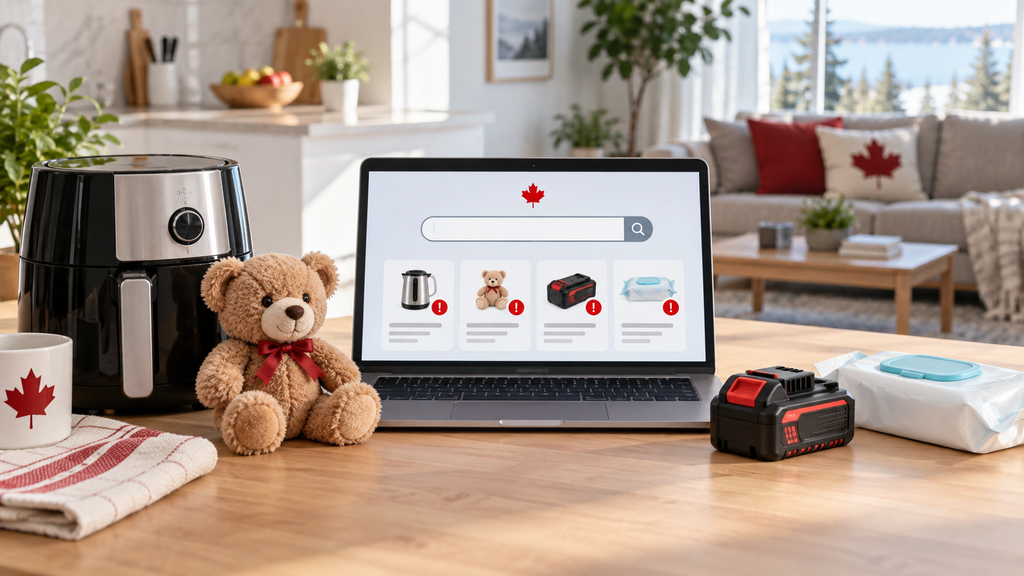
Start with the official database and search using the product name, brand, manufacturer, or a distinctive phrase from the label.
Search the official Canadian Recalls and Safety Alerts database
The database also includes archived notices, which is useful when researching older products or checking an item offered through a used-goods marketplace.
A recall notice normally answers four practical questions: what is wrong, which products are affected, what risk is involved, and what consumers should do next.
| Notice section | What to look for |
|---|---|
| Product identification | Brand, model, lot, serial number, size, UPC, date code, or other matching details. |
| Hazard | The possible risk, such as fire, electric shock, choking, burns, laceration, poisoning, or food contamination. |
| What consumers should do | Stop using the product, unplug it, discard it, return it, contact the company, or arrange a repair, replacement, or refund. |
| Where it was sold | Retailers, online marketplaces, provinces, dates of sale, or distribution locations. |
Follow the remedy in the notice rather than relying on a general internet comment or a seller’s informal explanation. Some recalled products can be repaired or replaced, while others should be discarded immediately. For food, medicine, cosmetics, and products that may have caused an injury, the notice may include additional handling or medical guidance.
Health Canada offers a free email subscription service. You can choose English or French notifications, receive a daily digest or individual messages as alerts are posted, and select categories such as electronics, appliances, toys, household products, food, allergens, drugs, medical devices, or natural health products.
Subscribe to Health Canada recall email alerts
Vehicle recall email subscriptions are not offered through this Health Canada form. For cars, trucks, tires, and child car seats, use Transport Canada’s manufacturer lookup and notification information instead.
Check Transport Canada vehicle, tire, and child car seat recall information
If you want more control than email, Health Canada also provides RSS feeds for categories including consumer products, cannabis, health products, medical devices, food, allergens, vehicles, tires, and child car seats.
Open Health Canada recall RSS feeds and data options
RSS is useful for retailers, resale businesses, libraries, childcare organizations, journalists, and anyone who wants alerts to appear in a feed reader. Health Canada also publishes recall and alert data in CSV and JSON formats, with the dataset updated daily. That makes the database more useful for structured research or internal product-checking systems.
For an occasional household check, the searchable website and email subscription are usually simpler. RSS and data feeds make more sense when you monitor many product categories or need a repeatable process.
Stop using the product if the notice says to do so, especially when the hazard involves fire, overheating, electric shock, choking, poisoning, or serious injury. Unplug or isolate it only if doing so is safe. Keep the product away from children and pets, and do not give it away or list it for resale.
Then follow the company’s remedy instructions. You may be asked to contact the manufacturer, upload proof of purchase, return the item, schedule a repair, or dispose of it in a specific way. Keep photos of the label and your receipt until the issue is resolved.
If the product caused an injury, near miss, property damage, bad reaction, or other safety concern, you can report the incident to Health Canada. Include what happened, when it happened, where you obtained the product, identifying numbers, and photos if available.
Report a consumer product safety incident to Health Canada
You do not need to report a recall that Health Canada has already published simply to notify the department. The incident-reporting form is for additional experiences or safety concerns that may help identify broader risks.
A product sold in both countries may have related Canadian and U.S. notices, but the affected models, retailers, remedies, and distribution dates may differ. A U.S. recall is not automatic proof that the same item is recalled in Canada, and a Canadian notice may not appear in a U.S. database.
For products sold in the United States, check the U.S. Consumer Product Safety Commission’s recall database. It supports keyword searches, filters, downloadable recall data, and links to email notifications.
Search U.S. Consumer Product Safety Commission recalls
For a Canadian purchase, give priority to the Canadian notice and the Canadian manufacturer or retailer instructions. For a cross-border purchase, check both databases and keep the original seller’s documentation.
A. No. The database contains published Canadian recalls, advisories, and safety alerts, but a product may still be under investigation or may have a problem that has not yet led to a public notice. You can report an injury, near miss, property damage, or safety concern to Health Canada.
A. No. Recalls commonly apply to specific models, production dates, lot codes, serial-number ranges, sizes, or versions. Compare the identifying details on your item with the full recall notice.
A. Do not list or give away a product covered by an active safety recall. Follow the official notice and complete the stated repair, replacement, refund, or disposal process first. If the notice does not clearly explain resale after a remedy, contact the manufacturer or the relevant Canadian authority.
A. Health Canada’s email subscription includes selected food, consumer product, and health-related categories, but its subscription form says vehicle recall notifications are not offered there. Use Transport Canada and the vehicle, tire, or child car seat manufacturer for those notices.
Featured image: Christina Morillo / Pexels / Pexels License