Welcome to KnowHow Daily!
Practical guides, money-saving tips, tech solutions, government benefits, and useful information for everyday life.
Welcome to KnowHow Daily!
Practical guides, money-saving tips, tech solutions, government benefits, and useful information for everyday life.

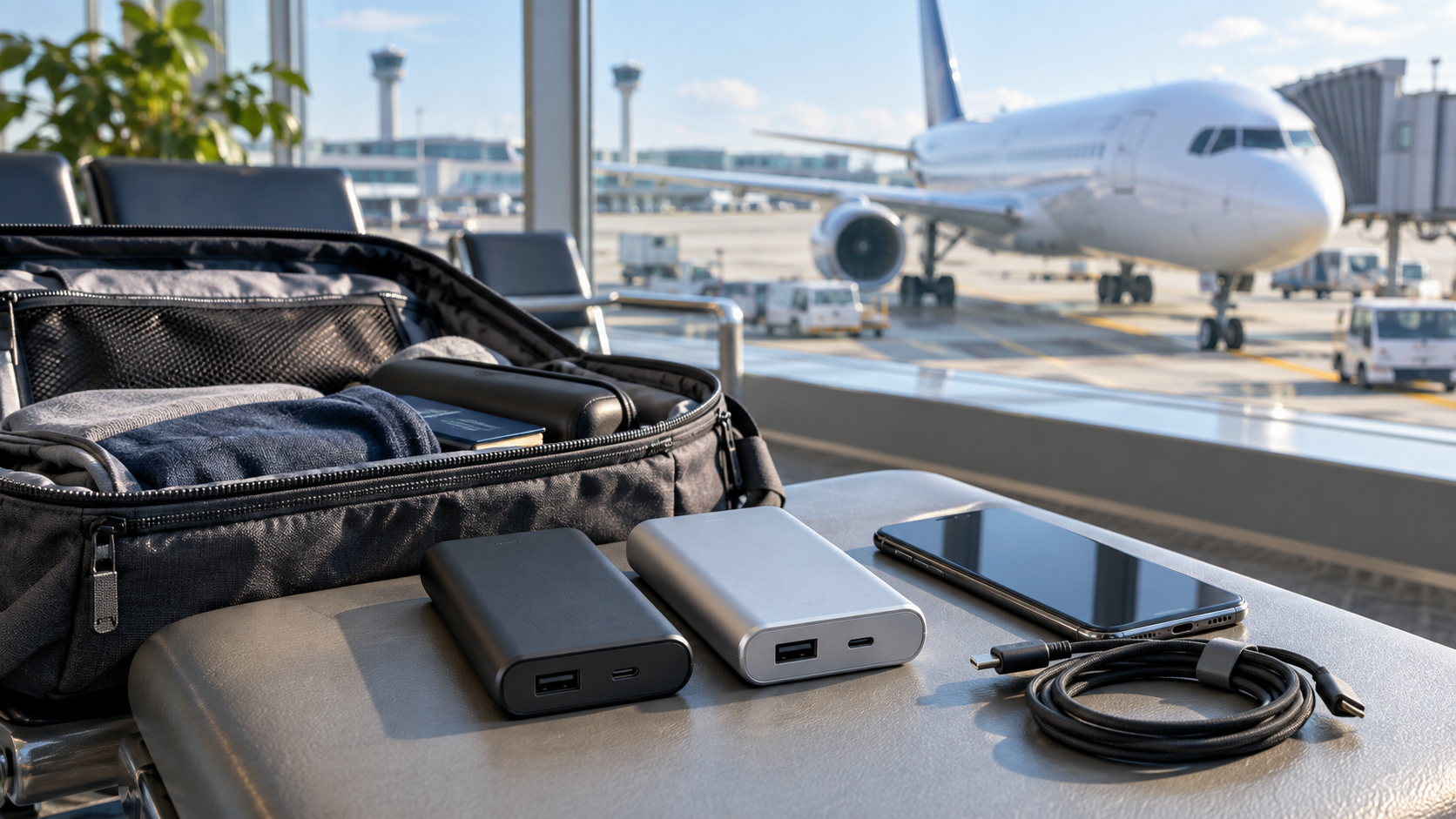
Learn which power banks under 100Wh you can bring on a plane, where to pack them, how to calculate Wh, and why airline limits may be stricter.
For travelers in Canada and the United States, a typical lithium-ion power bank rated at 100 watt-hours (Wh) or less is generally permitted on a passenger flight. The key rule is that a power bank is a spare battery: it must travel in the cabin, not in checked baggage.
That means a portable charger can usually go in your personal item or carry-on bag, but not inside a suitcase that you hand over at check-in. If an airline takes your carry-on at the gate and places it in the aircraft hold, remove the power bank first and keep it with you.
The 100Wh figure is a capacity limit, not a charging-speed rating. A power bank advertised as 20,000mAh or 27,000mAh may be allowed, but the watt-hour rating printed on the product or its packaging is the number airport staff and airlines use.
View the official FAA PackSafe lithium battery rules
Watt-hours measure how much energy a battery stores. To calculate the rating, multiply voltage by amp-hours:
Wh = volts (V) × amp-hours (Ah)
If the label shows milliamp-hours, divide that number by 1,000 before multiplying. For example, a power bank rated at 20,000mAh at a nominal 3.7 volts works out to approximately 74Wh:
3.7 × 20 = 74Wh
That is below the usual 100Wh threshold. A 27,000mAh power bank at 3.7 volts works out to approximately 99.9Wh, which is why many manufacturers market that size as an airline-friendly maximum.
Do not estimate from mAh alone if the voltage is unclear. Look for a printed Wh rating, a battery label, or the manufacturer’s specifications. If the rating is missing, unreadable or contradictory, the power bank may receive extra screening or be refused by the airline.
The Federal Aviation Administration treats a power bank as a spare lithium-ion battery or portable recharger. Spare lithium-ion batteries rated at 100Wh or less must be carried in carry-on baggage and protected against short circuits and physical damage. Power banks are not permitted in checked baggage.
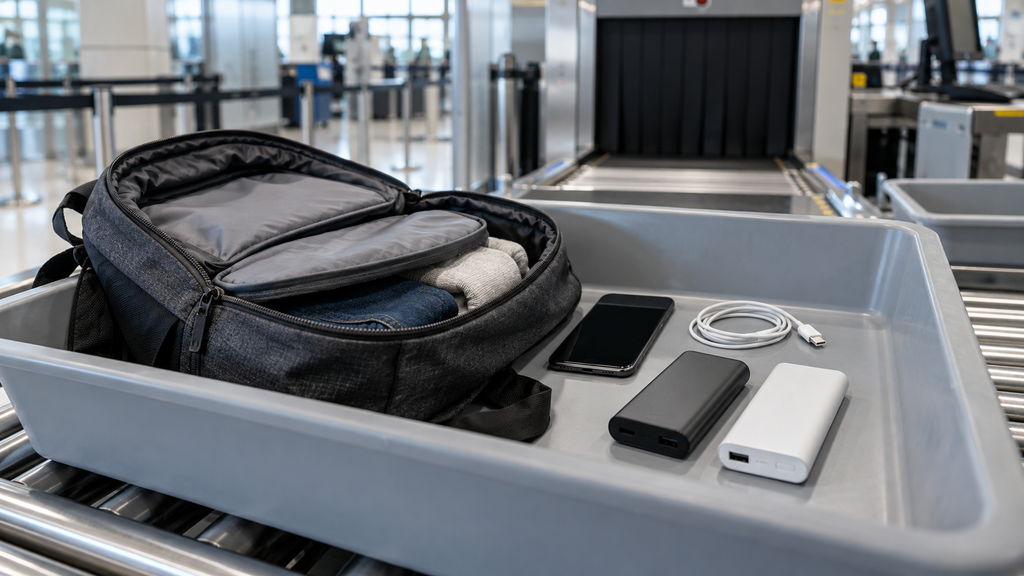
TSA’s screening guidance follows the same practical rule: portable chargers and power banks containing lithium-ion batteries belong in carry-on bags, not checked luggage. TSA officers can still conduct additional screening, and the final decision at the checkpoint rests with the screening officer.
For most ordinary consumer power banks, the useful U.S. rule is simple: under 100Wh, carry-on only, terminals protected, and accessible during the flight.
CATSA also identifies spare lithium-ion batteries of 100Wh or less as carry-on items. Its battery guidance says spare batteries are permitted in checked baggage only with air-carrier approval, but a power bank should be treated as a cabin item for normal passenger travel.
Canadian travelers should pay attention to the airline’s own policy as well as the screening rule. CATSA specifically warns that airlines may set tighter limits for the number of power banks, their storage location and whether they may be used or charged during the flight.
View CATSA’s official battery packing guidelines
There is no single worldwide quantity rule that works for every airline. U.S. federal guidance generally allows spare batteries for personal use, while also warning that airlines may impose stricter limits. International aviation guidance issued in 2026 recommends a maximum of two lithium-ion power banks of no more than 100Wh each, and airlines have been adopting similar restrictions.
Some carriers now publish a firm two-power-bank limit. Delta, for example, allows no more than two power banks per person, each rated at no more than 100Wh, and says they should remain accessible rather than being stored in an overhead bin.
Check Delta’s current battery and power-bank restrictions
That means a traveler carrying one 10,000mAh charger and one 20,000mAh charger will usually be within the limit. A traveler carrying four small chargers could still be refused even though each individual unit is below 100Wh.
For a multi-airline itinerary, follow the strictest rule that applies to any flight segment. A power bank accepted by your first carrier may still be restricted by a connecting airline or by the rules at your destination.
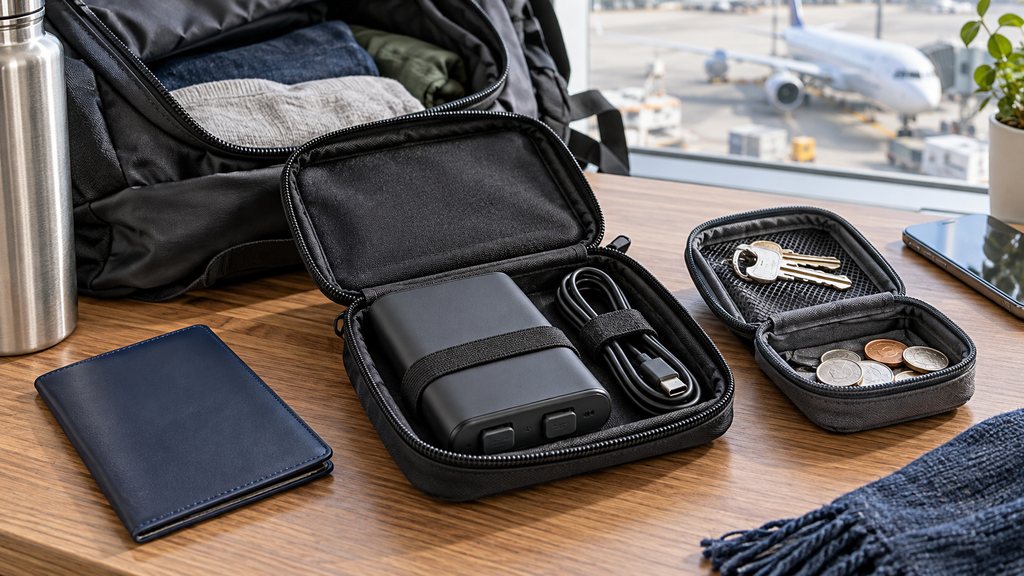
The safest place is an easily reachable pocket in your personal item or carry-on bag. Avoid burying it under clothing, placing it loose beside keys and coins, or putting it in an overhead compartment where you cannot quickly retrieve it.
Protect the power bank from accidental activation, crushing and punctures. If it has exposed contacts, place it in its original packaging, a protective pouch or a separate plastic bag. A power bank with built-in ports is normally protected by its casing, but it should still be kept away from metal objects.
Do not assume that permission to carry a power bank also means permission to use it. Airlines are increasingly restricting onboard use and charging.
Current international passenger guidance says power banks should not be recharged from an aircraft power outlet and should not be used to charge another device during taxi, takeoff or landing. Some airlines apply broader restrictions throughout the flight, while others may allow limited use when the crew permits it.
The practical approach is to charge the power bank before leaving for the airport, keep it accessible, and follow the cabin crew’s instructions. Never leave a power bank charging unattended, place it under a blanket or seat cushion, or continue using it if it becomes unusually hot, swollen, damaged or smoky.
A power bank above 100Wh is not an ordinary “carry-on safe” purchase. Under general aviation rules, a lithium-ion battery between 101Wh and 160Wh may be carried only with the airline’s approval, and spare batteries in that range are limited to two per passenger.
Airlines may apply stricter rules specifically to power banks. Some carriers do not accept power banks above 100Wh at all, even though larger spare lithium batteries may be permitted for certain professional equipment. Do not rely on a general battery rule when the item is a portable charger.
Anything above 160Wh is generally prohibited on passenger aircraft unless a specialized exception applies, such as certain mobility equipment handled under separate procedures.
A reputable power bank should have a clear manufacturer label showing capacity, voltage or watt-hours, along with safety and certification information appropriate to the market where it is sold. Avoid bringing a battery with a missing label, a counterfeit-looking specification or an implausibly high capacity for its size.
Do not fly with a power bank that is swollen, cracked, leaking, recalled, unusually hot or damaged. Aviation authorities prohibit damaged or recalled lithium batteries that could spark or overheat. A protective case does not make a defective battery safe to carry.
Also remember that the usable energy delivered to your phone will be lower than the battery’s advertised internal capacity because charging involves conversion losses. That affects how many times it charges your phone, but it does not change the airline’s Wh calculation.
For most travelers, the low-risk choice is a clearly labelled power bank between roughly 10,000mAh and 20,000mAh, carried in an accessible personal item. A larger unit may still be legal, but the closer it gets to 100Wh, the more important the label and airline-specific policy become.
A. Usually, yes. At a nominal 3.7 volts, 20,000mAh is approximately 74Wh, which is below the common 100Wh limit. Confirm that the product’s own label shows a compatible rating and follow your airline’s quantity and onboard-use rules.
A. It may be. At 3.7 volts, 27,000mAh is approximately 99.9Wh, but the actual rating depends on the battery voltage and the manufacturer’s specification. Bring it only if the label clearly identifies it as 100Wh or less.
A. Yes, if the backpack is your personal item or carry-on and remains in the cabin. Keep the power bank protected and accessible. Do not place the backpack in checked baggage or allow it to be gate-checked without removing the battery.
A. Possibly, but the airline may limit the total number even when every unit is under 100Wh. Because two power banks is becoming a common carrier limit, check the operating airline’s current rule before traveling with more than two.
A. Stop using it if it is safe to do so, do not place it in a bag or cover it, and alert the cabin crew immediately. Flight crews are trained to respond to lithium-battery overheating and smoke in the cabin.
Featured image: nappy / Pexels / Pexels License