Welcome to KnowHow Daily!
Practical guides, money-saving tips, tech solutions, government benefits, and useful information for everyday life.
Welcome to KnowHow Daily!
Practical guides, money-saving tips, tech solutions, government benefits, and useful information for everyday life.

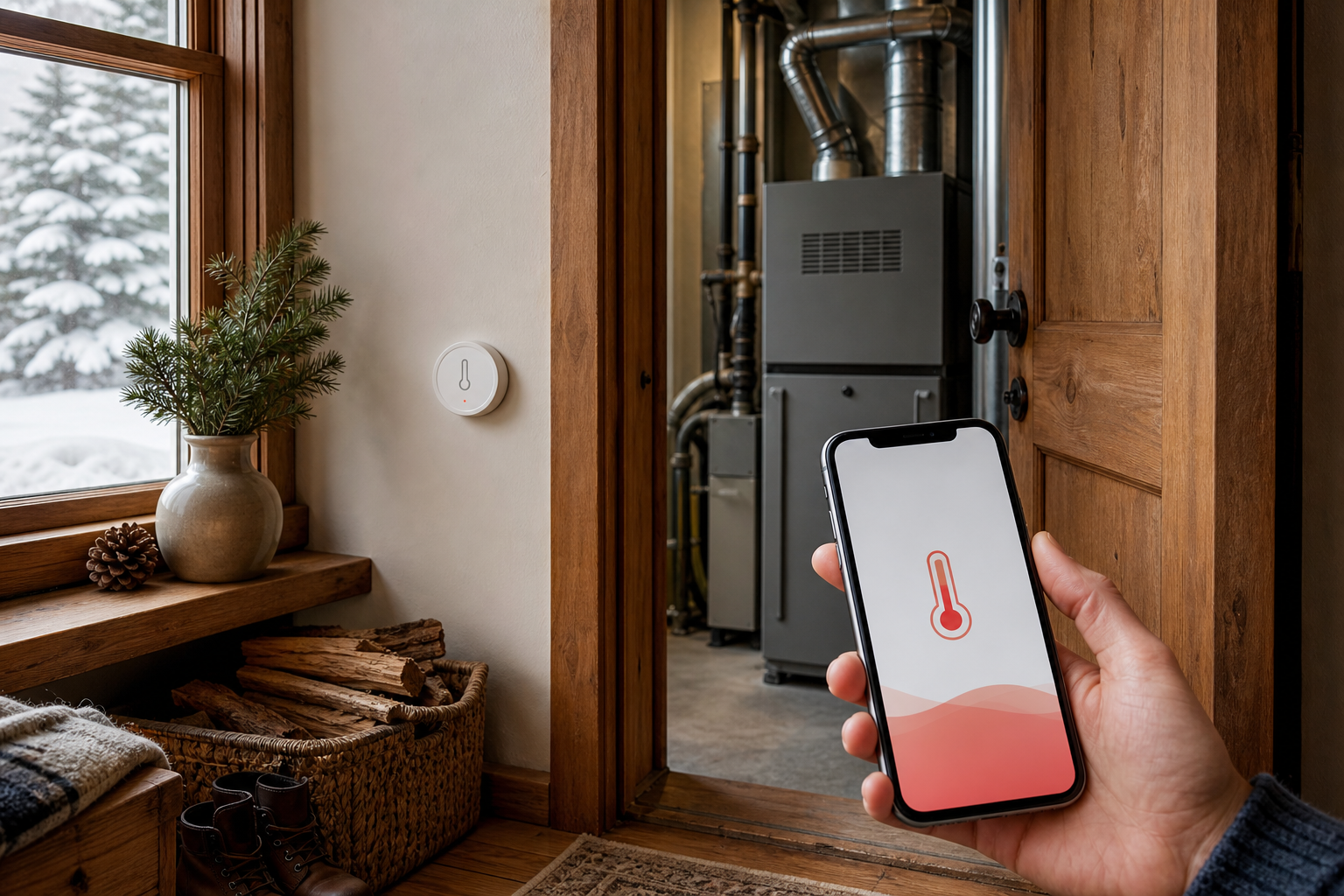
Compare Wi-Fi and cellular freeze alarms for cottages and vacant homes, including reliability, power outages, subscriptions, insurance considerations, and setup.
For a cottage or vacant home that may sit unattended for days or weeks, a cellular freeze alarm is usually the more dependable choice. It has its own mobile connection, so it does not depend on the property’s router, modem, or internet service to send an alert.
A Wi-Fi freeze alarm can still be an excellent fit when the home has reliable broadband, year-round power, and a nearby person who can investigate quickly. It is generally simpler and may avoid a separate cellular subscription, but every part of the internet connection has to keep working: the sensor, hub or router, modem, internet service, cloud platform, and alert system.
The key distinction is not whether the sensor measures temperature accurately. Both types can do that. The real question is whether the alarm can still reach you when the property has lost internet or power—the exact conditions that often accompany a furnace failure or severe winter storm.
A Wi-Fi system connects a temperature sensor directly to the home’s wireless network, or connects sensors to a hub that uses Wi-Fi or Ethernet. When the temperature crosses your chosen threshold, the platform sends a push notification, email, text, or other alert through the internet.
Wi-Fi systems are convenient for homes that already have a strong network. Some models also monitor humidity, water leaks, power loss, or multiple rooms. The main weakness is dependency: if the internet service fails, the router is unplugged, or the network configuration changes, remote alerts may stop.
A cellular alarm includes a built-in modem and SIM or embedded mobile connection. It communicates directly with a cellular network rather than using the property’s internet service. Many models also include a battery that keeps the unit operating temporarily during a power failure.
That independence is valuable at a remote property. A cellular unit can continue reporting a cold indoor temperature or a power outage even when the furnace, router, or broadband connection has failed. The trade-off is a higher total cost because cellular monitoring normally includes a recurring service plan.
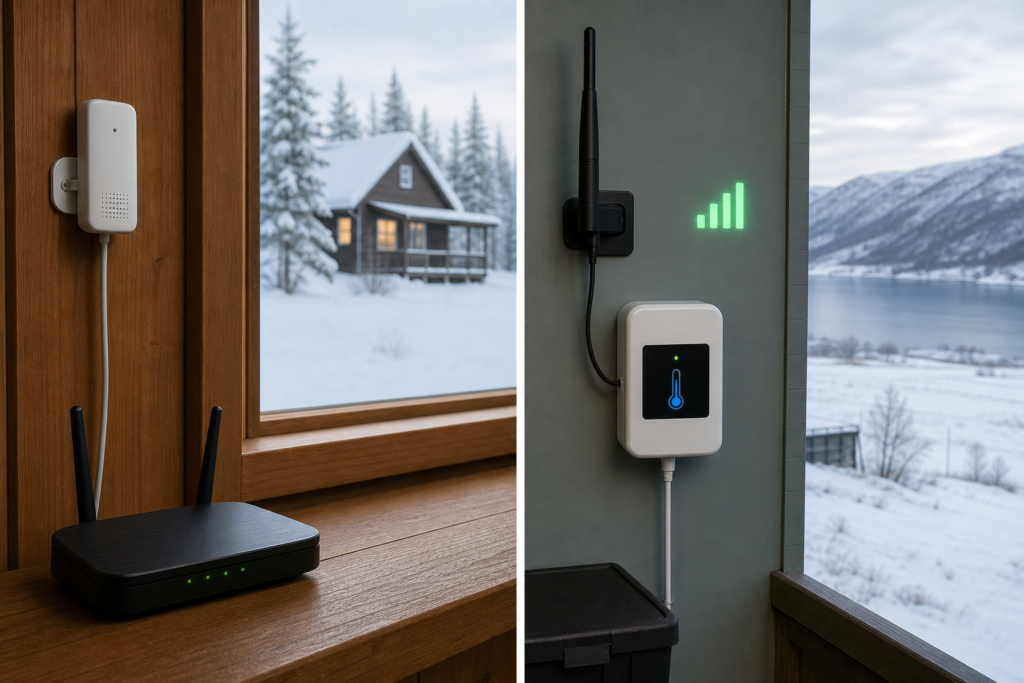
| Factor | Wi-Fi alarm | Cellular alarm |
|---|---|---|
| Internet required at the property | Yes | No |
| Separate monitoring subscription | Often not, although internet service is still required | Usually yes |
| Works when home internet fails | Usually no, unless paired with cellular backup | Usually yes, if cellular coverage remains available |
| Works during a power outage | Only if the sensor, network equipment, and internet equipment have suitable backup power | More likely, if the alarm has battery backup and the local cellular network remains active |
| Best fit | Connected homes, short absences, and lower-cost monitoring | Remote cottages, vacant homes, and properties without dependable broadband |
| Main limitation | Several internet-dependent failure points | Subscription cost and cellular coverage requirements |
Wi-Fi is a reasonable choice when all of the following are true:
It can also make sense when you already use a broader smart-home system and want one app for temperature, water, smoke, cameras, and security. A direct Wi-Fi sensor may be inexpensive, but check whether it needs a hub and whether alerts are included without a paid plan.
Do not assume that a strong Wi-Fi signal in the living room means the basement, crawl space, garage, or utility room is adequately covered. Test the exact installation location before leaving the property unattended.
Cellular is the stronger choice when the property is remote, the internet is seasonal, or the consequences of a missed alert would be serious. It is especially useful for a cottage that has power but no active broadband service, or for a vacant home where the heating system is the only thing preventing major damage.
Commercial and residential cellular monitors commonly offer temperature, humidity, power-loss, and leak alerts. Some services support calls, text messages, and email, while others provide a history of readings that can help you understand whether the temperature is falling gradually or dropping rapidly.
Before buying, verify that the specific model supports the cellular networks available at the property. Coverage can differ between carriers, regions, and even sides of a building. A device that works well in one part of Canada or the United States may not work at a rural cottage several miles away.
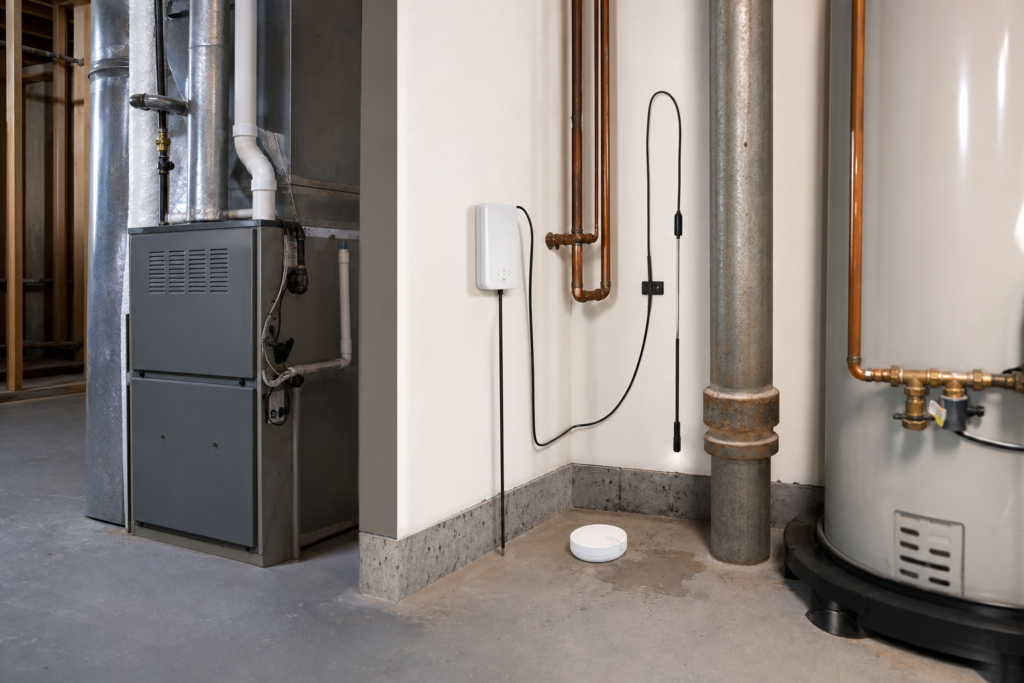
A temperature alarm that only reports cold conditions may alert you too late. Look for a separate power-loss alert so you know when the furnace, well pump, router, or alarm itself may have stopped working.
Battery backup gives the alarm time to send a power-failure notification and continue monitoring. Check the manufacturer’s stated runtime, how the battery is replaced or recharged, and whether the backup powers only the sensor or also the communication equipment.
An external probe can be placed near a vulnerable pipe, furnace room, crawl-space entrance, or other cold spot. This is often more useful than measuring the temperature beside the alarm in a centrally heated room.
Temperature monitoring addresses one cause of water damage, but a leak sensor can identify a failed water heater, burst pipe, appliance hose, or thawing leak directly. If the system supports it, place leak sensors near the main water entry, furnace or boiler, water heater, sump pump, and other high-risk areas.
Choose a system that can notify more than one person and report when the device stops communicating. An alarm that sends one push notification but cannot confirm that the device is online is less useful for a vacant property.
Not automatically. Insurance rules for vacant or seasonally occupied homes differ by policy, province, state, insurer, and the length of the absence. Some policies require regular visits by a competent person, continued heat, water shutoff and drainage, or a professionally monitored alarm. A consumer-grade sensor may help you respond faster, but it may not replace a condition written into your policy.
Before relying on any alarm, ask your broker or insurer whether the exact system qualifies, how often the property must still be inspected, and what records you should retain. If the insurer requires a monitored alarm, ask whether self-monitored phone alerts meet that definition.
Read the official Insurance Bureau of Canada guidance on extreme cold damage
Also remember that an alarm is a warning system, not winterization. The property may still need a serviced heating system, adequate insulation, a safe thermostat setting, water shutoff or drainage where appropriate, and a local response plan.
Use this rule of thumb:
Whichever connection you choose, install the sensor before the heating season, test alerts from outside the property, trigger a controlled power-loss test, confirm the battery condition, and arrange a person who can reach the home quickly. For a remote cottage, the best alarm is not the one with the most smart-home features; it is the one that can communicate a problem and lead to action before pipes freeze or thawing water causes damage.
A. It may continue recording locally, but remote alerts usually cannot reach you without an internet connection. Some systems can use a cellular backup router or a professionally monitored alarm, but that creates an additional setup and cost.
A. No. It needs compatible cellular coverage at the property, and coverage can vary by carrier, terrain, building construction, and network technology. Confirm coverage for the exact device and location before purchasing.
A. Many U.S. insurers and winterization guides use 55°F, or about 13°C, as a general minimum when water remains in the plumbing. Your heating system, building design, local climate, and insurance policy may require a different approach. If the property will not be heated, professional draining and winterization may be appropriate.
A. A freeze alarm does not prevent a pipe from freezing or bursting. Shutting off and draining the water can reduce the amount of damage, but the correct procedure depends on plumbing, boilers, sprinkler systems, wells, and other equipment. Ask a qualified plumber or your insurer before changing the setup.
A. Usually, you should not assume that it is. Ask your insurer whether the exact device and monitoring arrangement satisfy the policy, and whether regular in-person inspections, heat maintenance, or water shutoff are still required.