Welcome to KnowHow Daily!
Practical guides, money-saving tips, tech solutions, government benefits, and useful information for everyday life.
Welcome to KnowHow Daily!
Practical guides, money-saving tips, tech solutions, government benefits, and useful information for everyday life.

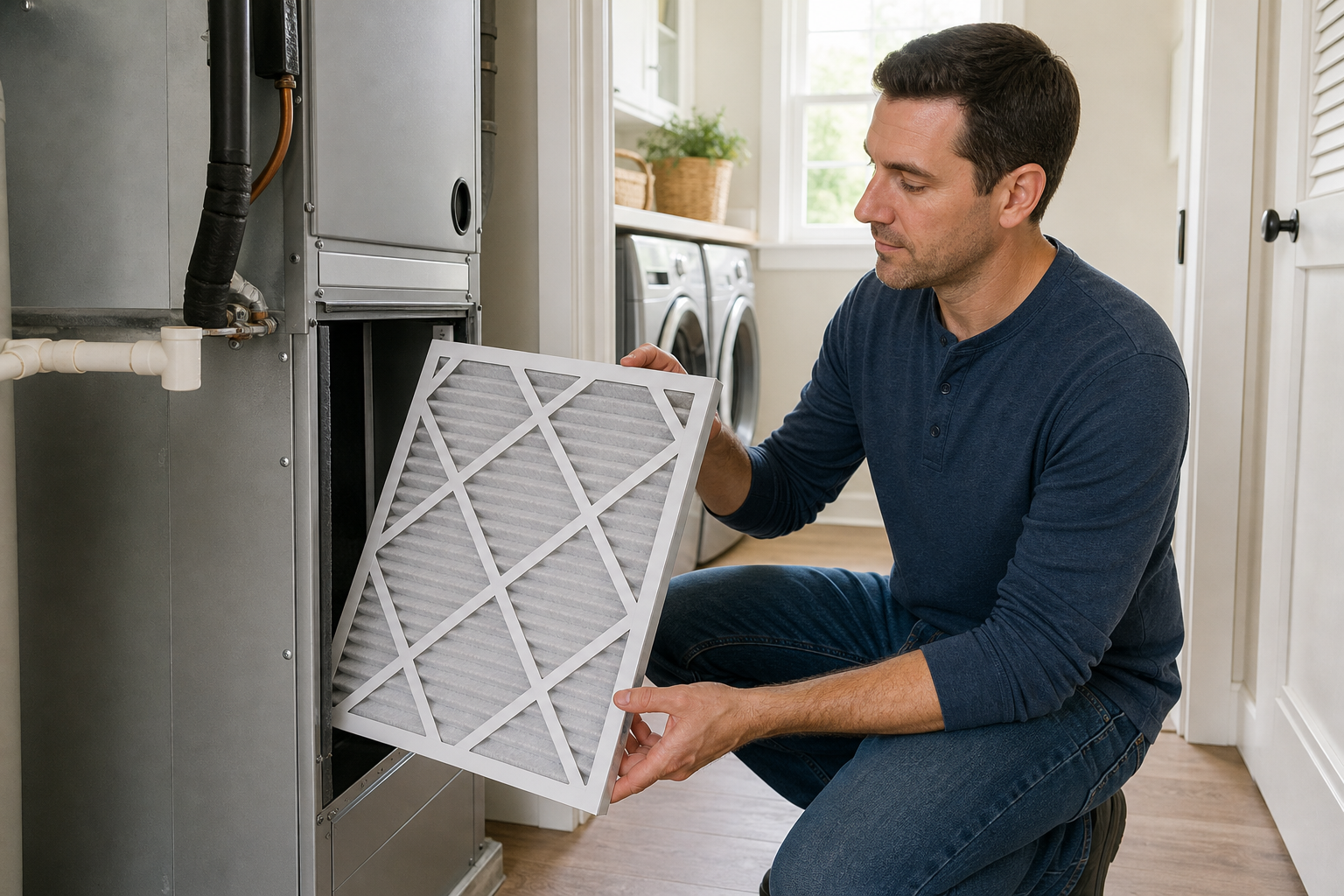
Learn how to choose the right furnace filter by comparing MERV rating, actual size, thickness, airflow, replacement timing, and HVAC compatibility.

For many U.S. homes, MERV 11 to MERV 13 is a reasonable range to investigate. The U.S. Environmental Protection Agency says homeowners who upgrade should choose MERV 13, or the highest rating their system fan and filter slot can accommodate. That last part matters more than the number on the package.
MERV stands for Minimum Efficiency Reporting Value. It measures how effectively a filter captures particles in several size ranges, from larger dust and pollen particles to smaller particles that can affect indoor air quality. A higher MERV rating generally captures more and smaller particles, but it can also create more resistance as air passes through the filter.
That means the right choice is not simply “the highest MERV available.” It is the highest useful rating that works with your equipment, filter slot, household needs, and replacement habits.
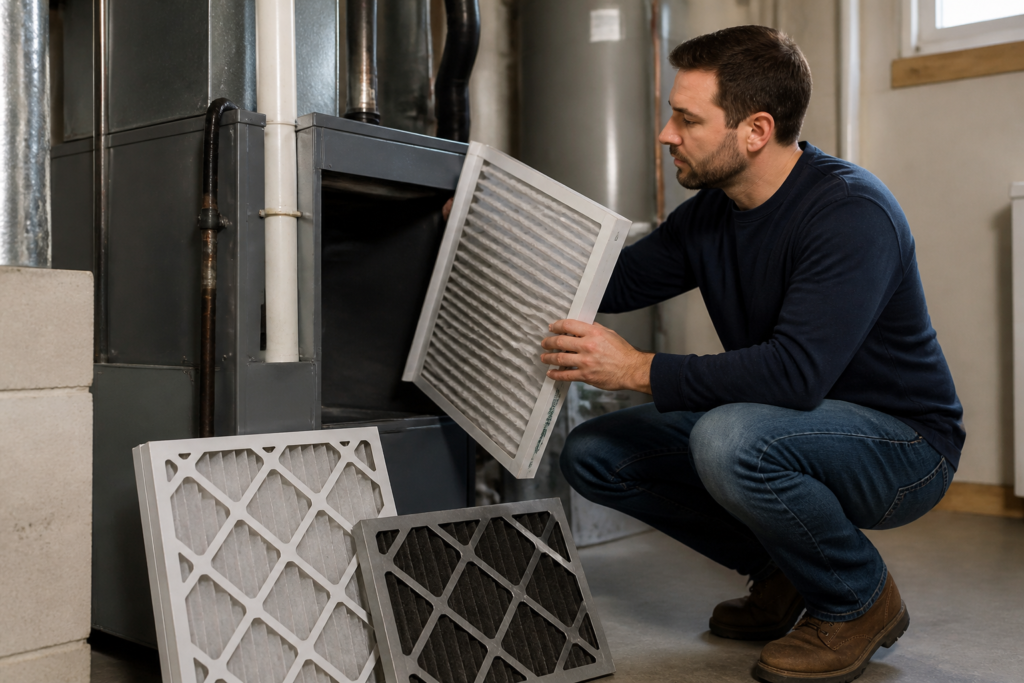
Your furnace or air handler needs enough airflow to heat or cool the home properly. A filter with greater resistance can reduce airflow, make the blower work harder, increase operating costs, and contribute to comfort problems if the system is not designed for it.
ASHRAE notes that upgrading to a higher MERV filter requires consideration of the filter’s airflow resistance. The actual pressure drop depends on more than the MERV number. Filter thickness, surface area, construction, airflow rate, and how dirty the filter has become all matter.
A dirty MERV 8 filter can restrict airflow more than a clean, well-designed MERV 13 filter. Thicker filters often have more media surface area and may provide higher filtration with less resistance than a thin filter, but only if the HVAC system has room for that thickness.
Watch for warning signs after installing a new filter: weak airflow from vents, unusual blower noise, longer heating or cooling cycles, rooms that no longer reach the thermostat setting, or a system that shuts down unexpectedly. These symptoms do not prove the filter is the cause, but they are good reasons to reinstall the previous filter and arrange an HVAC inspection.
Filter fit is just as important as filtration efficiency. A filter that is too small can allow air to bypass the media, while one that is too large may bend, collapse, or fail to slide fully into the slot.
Start by removing the current filter and reading the size printed on its frame. Record all three dimensions: length, width, and thickness. Also note the airflow arrow and the filter’s installation location so the replacement goes in the same direction.
Filter packaging commonly displays a nominal size, such as 16 by 25 by 1 inches. The actual filter may be slightly smaller so it can slide into the filter rack. Do not assume that two filters with the same printed nominal size will have identical actual dimensions. Check the manufacturer’s listed actual size when the fit is tight or the existing filter does not have a clear label.
The replacement should sit securely in the track or grille. It should not need to be crushed into place, and you should not see obvious gaps around the edges. If the slot is damaged, warped, or much larger than the filter, a technician may be able to improve the seal with a properly fitted rack or gasket.
Yes. Common residential filters range from about 1 to 5 inches thick, but your system is built for a specific filter depth. A 4-inch filter cannot replace a 1-inch filter unless the system has a compatible media cabinet or filter rack.
Thicker filters can offer more media area, which may help balance filtration and airflow. They also tend to cost more and may not be available in every size. The important question is not whether a thicker filter is automatically better; it is whether your equipment was designed to accept it.
Never force a thicker filter into a 1-inch slot or remove a filter-door panel to make room. If you want to move from a thin filter to a deeper media filter, have an HVAC professional evaluate the installation and make the necessary modifications.
| Filter rating | Often makes sense for | What to confirm |
|---|---|---|
| MERV 8 | Basic dust, lint, and pollen control in systems with limited filter capacity | That it fits properly and is replaced before it becomes visibly dirty |
| MERV 11 | Homes seeking stronger particle filtration without moving immediately to MERV 13 | That the equipment can handle the filter’s pressure drop |
| MERV 13 | Homes prioritizing better capture of smaller particles, including during periods of smoke or elevated indoor-air concerns | Manufacturer guidance, filter pressure drop, available space, and replacement frequency |
These are practical categories, not universal equipment rules. Two filters with the same MERV rating can have different airflow resistance, so compare the manufacturer’s performance information when it is available. A technician can also determine the highest filter efficiency that your system can use reliably.
There is no single schedule that works for every home. EPA guidance says manufacturers commonly recommend replacement every 60 to 90 days, but the correct interval depends on filter thickness, household size, pets, construction dust, wildfire smoke, indoor pollution, and how often the HVAC system runs.
Check the filter about once a month, especially during heavy heating or cooling periods. Replace it sooner if the media is visibly loaded with dust or if airflow has noticeably declined. A filter that looks dirty after 30 days should not be left in place simply because the package says 90 days.
Homes with pets, smokers, allergy concerns, several occupants, or frequent wildfire smoke may need more frequent changes. During smoky conditions, EPA recommends paying close attention to filter condition and replacing it more often than the normal schedule when necessary.
Replacement cost is part of the decision. A higher-rated filter that costs more but needs to be replaced more often may be less practical than a moderately rated filter changed consistently. An affordable filter that is installed correctly and maintained on schedule is usually more useful than an expensive filter that is allowed to clog.
Ask for professional guidance before upgrading if you cannot find the equipment manual, the filter slot has no clear rating guidance, the system uses an unusual size, or you are considering a major jump in thickness or MERV rating.
A technician should also evaluate the system if you notice poor airflow, noisy operation, icing, overheating, repeated shutdowns, or large differences in room temperature after changing filters. These problems can have causes unrelated to filtration, including blocked returns, dirty coils, duct problems, or equipment faults.
For a rental home, check the lease or ask the property manager before modifying the filter rack or installing a different thickness. Replacing the correctly sized filter is usually routine maintenance, but changing the HVAC cabinet is not.
For most homeowners, the safest decision rule is straightforward: keep the exact correct size, use the highest MERV level the system can accommodate, and replace the filter before it becomes heavily loaded. If you cannot verify that MERV 13 is compatible, do not guess—use the equipment manufacturer’s guidance or have the system checked.
A. Not necessarily. EPA says many furnaces and HVAC systems can accommodate MERV 13, but the system fan, filter slot, filter thickness, and the specific filter’s resistance all matter. If the equipment documentation does not confirm compatibility, ask an HVAC technician before upgrading.
A. Only if the system has a filter rack or media cabinet designed for a 4-inch filter. A thicker filter should not be forced into a thinner slot or used as a cabinet modification.
A. A higher rating can capture more and smaller particles, but only while air is moving properly through the system. A filter that restricts airflow, does not fit, or is not replaced when dirty may undermine system performance.
A. Inspect it about monthly, especially during heavy-use seasons. Replace it when the media is visibly dirty, airflow declines, or the manufacturer’s replacement interval has arrived. Homes with pets, smoke, construction dust, or several occupants may need more frequent changes.