Welcome to KnowHow Daily!
Practical guides, money-saving tips, tech solutions, government benefits, and useful information for everyday life.
Welcome to KnowHow Daily!
Practical guides, money-saving tips, tech solutions, government benefits, and useful information for everyday life.

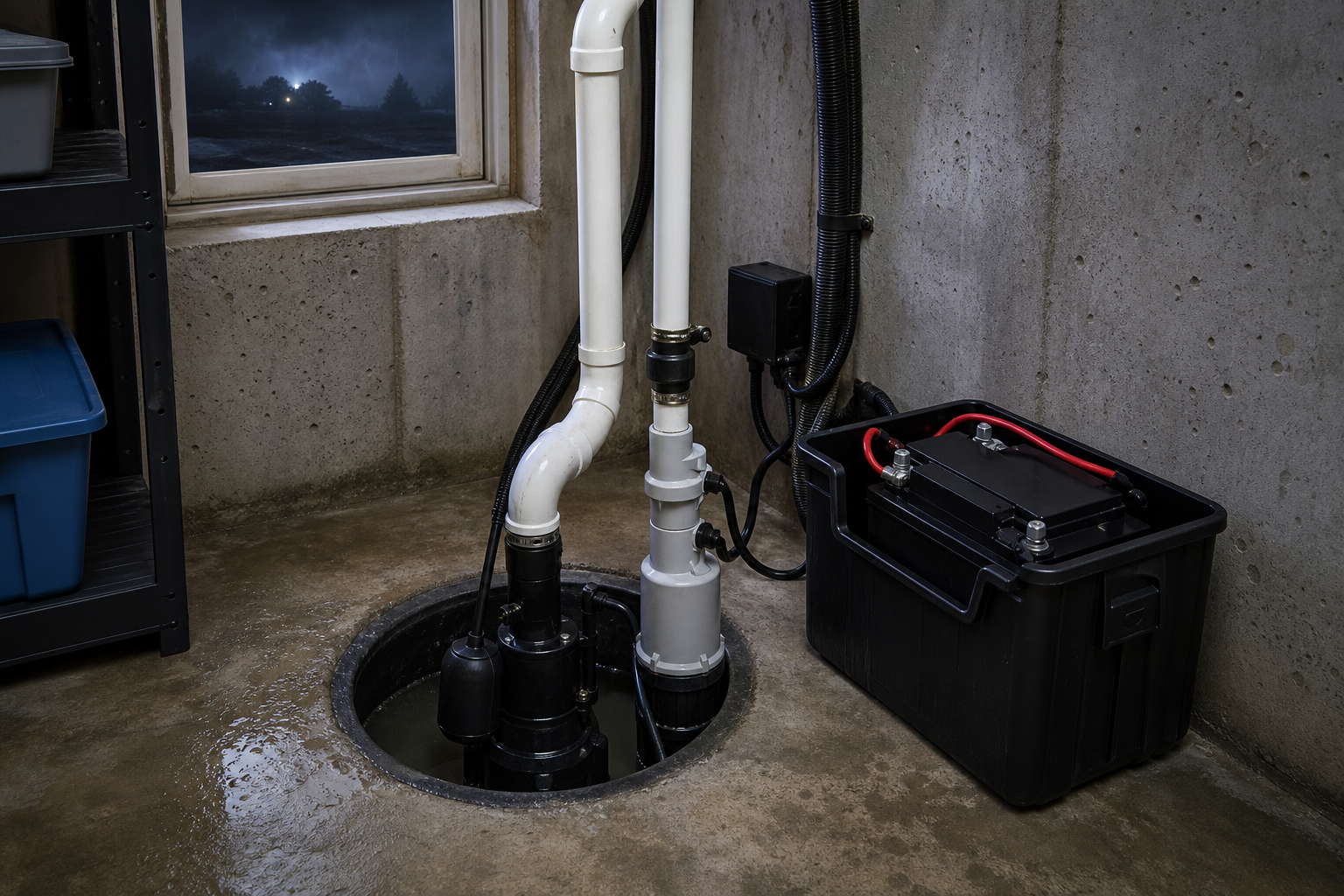
Learn what battery size your sump pump needs during a power outage, including amp-hour calculations, runtime examples, battery types, and sizing mistakes to avoid.
For a typical residential battery-backup sump pump, start by looking for a 12-volt deep-cycle battery rated around 75 to 105 amp-hours (Ah). A 75 Ah battery may be suitable for a lower-water-inflow home or a smaller backup pump, while a 105 Ah battery generally provides more reserve for longer outages and heavier pumping demands.
That range is only a starting point. The right sump pump battery backup size depends on four factors: the backup pump’s electrical draw, how high it must lift water, how often it cycles, and how long the outage may last. A battery that seems large enough on paper may run down quickly if groundwater is entering the pit continuously.
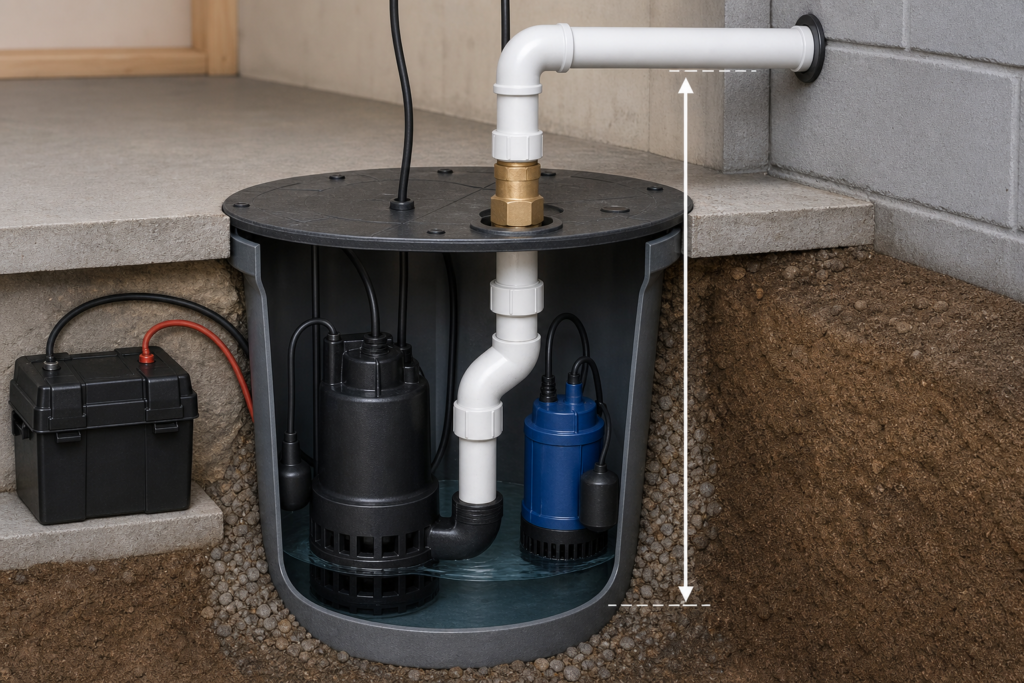
A battery backup system is normally a separate 12-volt DC pump that operates when the primary AC pump loses power or fails. It is not the same as plugging the existing 120-volt pump into an ordinary portable power station. The backup pump, battery, charger, controller, and discharge plumbing must be compatible as a system.
| Battery capacity | Best suited to | Important limitation |
|---|---|---|
| About 75 Ah | Small to moderate residential backup systems, shorter outages, and homes with relatively low inflow | May provide less reserve during heavy rain or frequent pump cycles |
| About 100–105 Ah | Many standard residential installations and longer outage protection | Still may not be enough for continuous pumping or high lift |
| About 110–120 Ah | Higher-demand systems where the manufacturer permits the larger battery | Must physically fit the battery box and remain compatible with the charger |
| Two batteries in parallel | Systems specifically designed for extended runtime | Never add a second battery unless the pump manufacturer supports the configuration |
Manufacturer guidance illustrates why there is no universal runtime number. Wayne lists a 75 Ah battery for one of its 12-volt backup pumps, while Zoeller recommends a 105 Ah marine battery or larger for a different emergency pump. Liberty publishes separate performance estimates for continuous pumping and intermittent cycling with a Group 31 battery. These systems are not interchangeable, so the battery recommendation in your own manual takes priority.
View Liberty’s official runtime literature View the official Zoeller installation instructions View the official Wayne ESP25n manualThe basic energy estimate is:
Battery capacity needed ≈ pump current in amps × actual pumping hours
For example, if a 12-volt backup pump draws 8 amps while operating and runs for a total of 4 hours during an outage, the simple estimate is 32 amp-hours. In real installations, you should add a safety margin because lead-acid batteries should not normally be drained completely, pump loads vary, and battery capacity decreases with age and temperature.
A more practical planning formula is:
Required Ah ≈ amps × total operating hours ÷ usable battery fraction
If the same pump needs 32 Ah and you plan to use only about 60% of the battery’s rated capacity, the result is roughly 53 Ah before adding an additional reserve. That could point you toward a 75 Ah battery rather than a smaller battery. If the pump may run for 8 hours in total, the same calculation rises to about 107 Ah before extra margin, making a 105–120 Ah battery more appropriate if the system allows it.
This calculation is an estimate, not a substitute for the manufacturer’s runtime chart. Pump efficiency, discharge height, pipe size, check valves, battery condition, and the charger design all affect the result.
A sump pump may operate for only a few minutes at a time, even during a 24-hour power outage. In that situation, the battery can last much longer than it would under continuous operation. Conversely, heavy rain, a high water table, or a blocked discharge line can make the pump run repeatedly and consume the battery quickly.
Manufacturers commonly publish runtime estimates using a stated duty cycle, such as the pump operating for approximately 10% of the time. Those estimates can be useful for comparison, but they should not be treated as a guarantee. If your pump runs once every few minutes, your actual runtime may be dramatically shorter than the advertised figure.
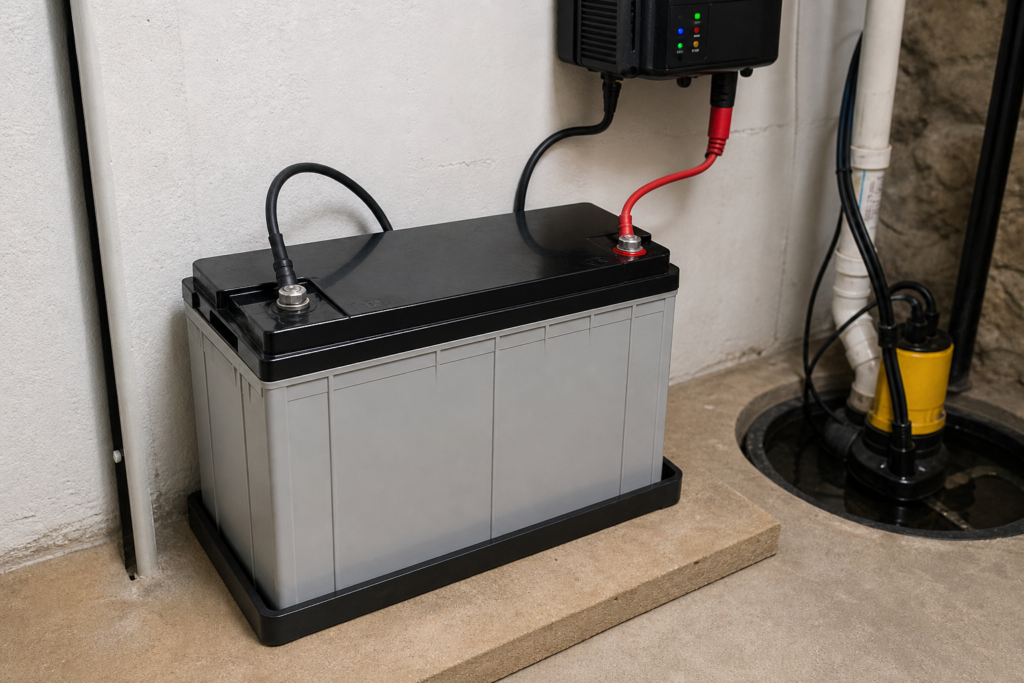
Use a 12-volt deep-cycle battery designed for repeated discharge and recharge. Common choices include flooded marine batteries, sealed AGM batteries, and other manufacturer-approved deep-cycle lead-acid batteries.
Do not use a standard automotive starting battery as a substitute. Starting batteries are designed to deliver a short burst of high current, not to provide repeated deep discharge. They may fail prematurely when used for sump-pump backup duty.
AGM batteries are sealed and do not require adding water, which can make them more convenient in a basement. Flooded batteries may provide strong performance but require proper ventilation, safe handling, and periodic maintenance. Some pump controllers include a fluid sensor that works only with specific battery designs.
Do not assume that a lithium battery, power station, or gel battery is compatible. The voltage, charging profile, battery-management system, temperature limits, and enclosure requirements must all match the sump pump equipment.
A bigger battery cannot compensate for an undersized backup pump, an undersized discharge pipe, a failing check valve, or a discharge route that is too high. If the backup pump cannot move incoming water fast enough, increasing battery capacity may only allow it to run longer without solving the flooding risk.
Homes with frequent outages or high groundwater may benefit from a complete backup strategy rather than one oversized battery. Options can include a manufacturer-approved two-battery setup, a second independent backup pump, a standby generator, or a professionally installed inverter system that is rated for the primary pump’s starting load.
If you are considering an inverter for the existing AC sump pump, size it for both the pump’s running wattage and its starting surge. A unit that can supply only the running watts may shut down when the motor starts. In many homes, a dedicated 12-volt backup pump is simpler because the pump and battery are designed to work together.
Bottom line: A 75 Ah battery may be adequate for some residential backup pumps, but a 100–105 Ah deep-cycle battery is a more common higher-reserve choice. The safest answer is the battery size specified for your exact pump model, adjusted upward only within the manufacturer’s approved limits.
A. Usually only if the pump manufacturer allows that battery size and the larger battery fits the approved enclosure. Confirm the charger’s compatibility, terminal layout, physical dimensions, and maximum supported capacity before upgrading.
A. No. Amp-hours primarily increase potential runtime. Pumping capacity depends on the backup pump, voltage, discharge piping, total lift, and water-flow conditions.
A. There is no single answer. It may last only a few hours if the pump runs continuously, or much longer if it runs briefly every few minutes. The manufacturer’s runtime chart is meaningful only when your lift height and pumping cycle resemble its test conditions.
A. Only when the backup system is specifically designed for parallel batteries and provides the correct jumper or connection method. Use matching batteries of the same type, age, and capacity, and follow the manufacturer’s wiring instructions.
A. Sometimes, but only if the power station is rated for the pump’s running wattage and motor-starting surge, has sufficient usable capacity, and can operate safely in the intended location. A dedicated DC backup pump is often easier to size and maintain.