Welcome to KnowHow Daily!
Practical guides, money-saving tips, tech solutions, government benefits, and useful information for everyday life.
Welcome to KnowHow Daily!
Practical guides, money-saving tips, tech solutions, government benefits, and useful information for everyday life.

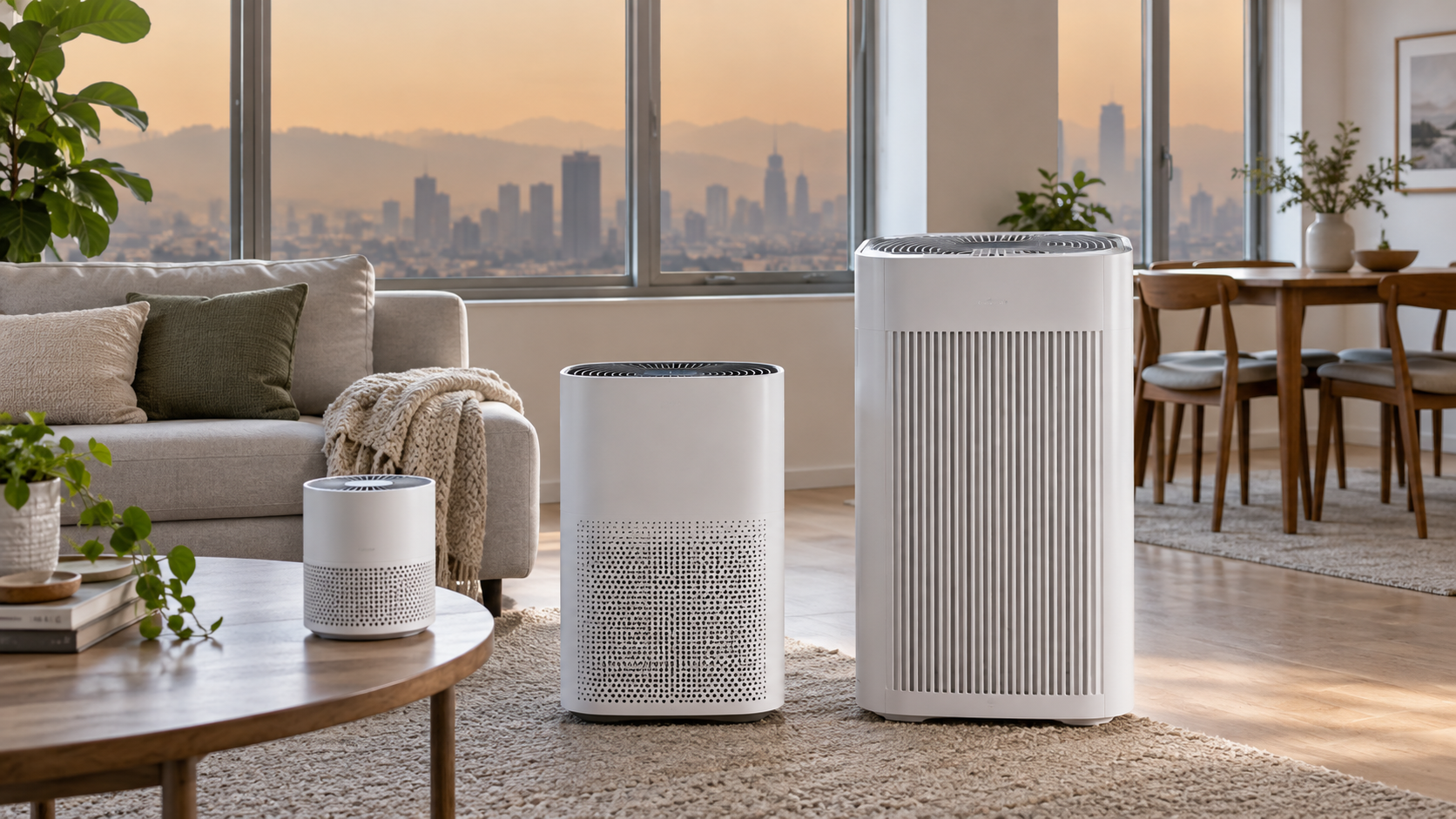
Learn how to size an air purifier for wildfire smoke in an apartment using room square footage, smoke CADR, ceiling height, and practical clean-air-room strategies.
For wildfire smoke, choose a portable air cleaner with a tobacco smoke CADR of at least two-thirds of the room’s area in square feet. CADR means Clean Air Delivery Rate, a measure of how quickly an air cleaner delivers filtered air. The tobacco smoke rating is the most useful of the three common CADR numbers because it represents smaller particles similar in size to much of the fine particle pollution in wildfire smoke.
For example, a 12-by-15-foot living room is 180 square feet. Two-thirds of 180 is 120, so look for a smoke CADR of at least 120 cubic feet per minute. A higher CADR will clean the room faster and gives you more capacity when outdoor smoke is severe.
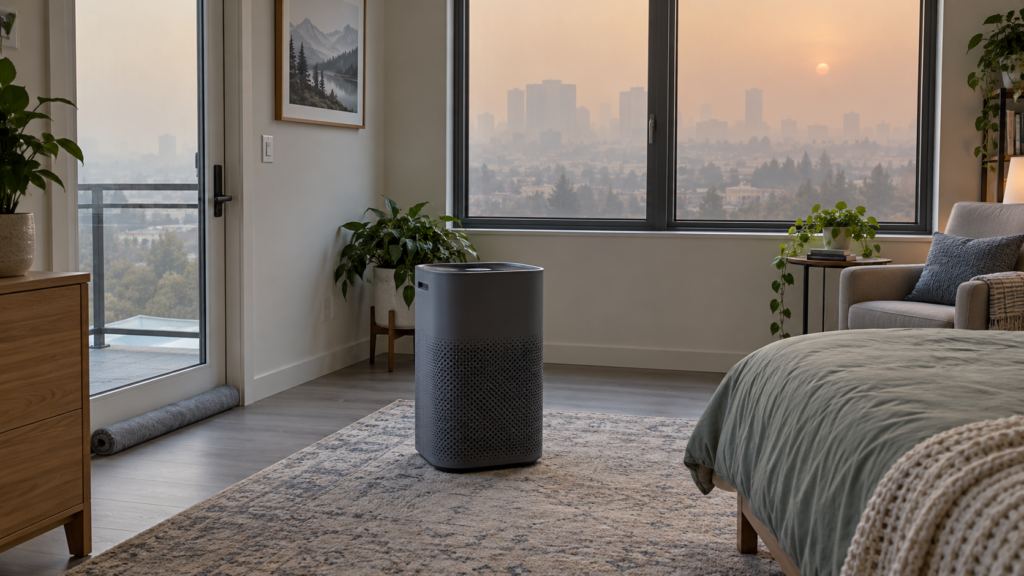
The most important distinction is this: a portable purifier is usually designed to clean one room or connected area, not an entire apartment with closed doors. If you are creating a cleaner-air room during a smoke event, size the unit for that room and keep the doors and windows closed as much as practical.
Measure the length and width of the room, then use this formula:
Minimum smoke CADR = room area in square feet × 0.67
| Room size | Minimum smoke CADR | Practical choice |
|---|---|---|
| 100 sq. ft. | About 67 CFM | A small bedroom unit rated above 70 CFM |
| 150 sq. ft. | About 100 CFM | A unit with at least 100 CFM smoke CADR |
| 200 sq. ft. | About 134 CFM | A unit with roughly 135–200 CFM smoke CADR |
| 300 sq. ft. | About 200 CFM | A medium or large-room unit around 200 CFM or higher |
| 500 sq. ft. | About 334 CFM | A high-CADR unit or two smaller units |
These calculations assume an approximately 8-foot ceiling. If your apartment has 10- or 12-foot ceilings, a lofted living space, or a large open floor plan, choose more capacity. A simple way to adjust is to multiply the room area by the ceiling height, divide by eight, and then apply the two-thirds CADR guideline.
For instance, a 200-square-foot room with 12-foot ceilings has about 1.5 times the air volume of the same room with an 8-foot ceiling. Instead of targeting a 134 CFM smoke CADR, look for roughly 200 CFM or more.
Usually, no—not with one small bedroom purifier placed in a corner. Air does not circulate evenly through closed bedrooms, bathrooms, hallways, and separate living areas, so a unit’s advertised coverage area should not be treated as a guarantee for every room in the apartment.
For a studio or compact open-plan apartment, one larger purifier may work if it is placed in the main occupied area and the airflow is not blocked by furniture. For a one- or two-bedroom apartment, a more reliable strategy is to use one properly sized purifier in the living room and a smaller unit in the bedroom where someone sleeps.
If you want to estimate capacity for a mostly open apartment, add the smoke CADR targets for the connected space. A 600-square-foot open area would need a minimum target of about 400 CFM under the basic formula. That could mean one unit with a smoke CADR near 400 CFM or two units whose smoke CADRs add up to at least that amount.
Separate rooms are different. Two units rated at 200 CFM each do not automatically clean a closed 400-square-foot apartment as effectively as one 400-CFM unit in a single open room. Placement, door positions, air leakage, and fan speed all matter.
Look for a published tobacco smoke CADR, preferably from the Association of Home Appliance Manufacturers’ verified ratings or a clearly documented manufacturer specification. If a product lists only a vague “up to 1,000 square feet” claim but does not provide a smoke CADR, it is harder to compare accurately.
A HEPA filter or another high-efficiency mechanical particle filter is a sensible choice for wildfire smoke. HEPA filtration targets airborne particles, including fine particulate matter. An activated-carbon filter can help with some odours and gases, but carbon performance varies widely and is not represented by the standard smoke CADR.
Do not buy an ozone generator as a wildfire-smoke solution. Ozone is itself an inhalation hazard, and some electronic air-cleaning technologies can produce ozone as a by-product. If a purifier includes an ionizer, plasma feature, UV system, or similar electronic function, choose a model that allows the feature to be switched off and verify that it has been independently tested for low ozone emissions.
CARB certification can help identify devices tested under California’s ozone-emissions rules, but certification does not tell you how effective a purifier is at removing smoke. Check both ozone information and the smoke CADR.
Check the CARB-certified air-cleaner list
A purifier may be powerful enough on paper but too loud to run while you sleep. Check the noise rating at the speed you are likely to use, not only the quietest setting. Also check replacement-filter availability and cost before buying; wildfire smoke can darken filters faster than normal household dust.
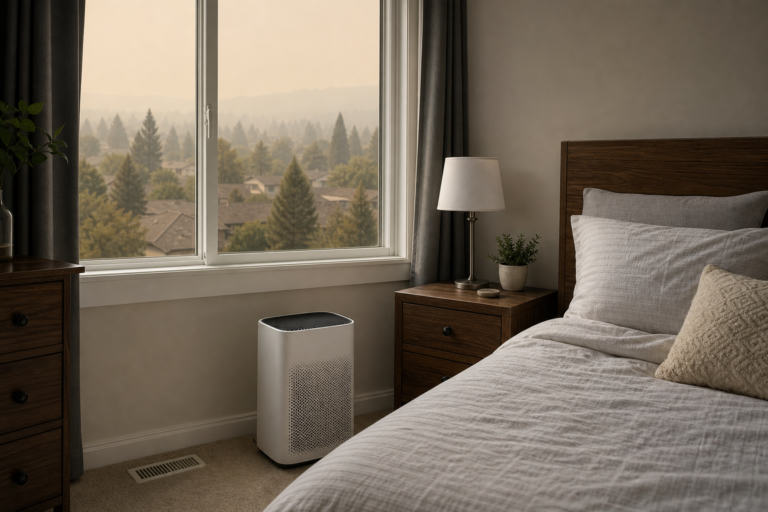
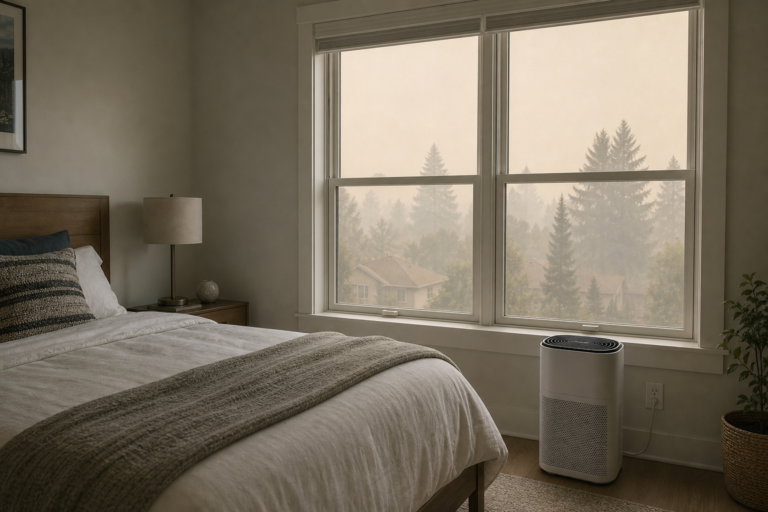
Place the unit in the room where people spend the most time, with clear space around the air intake and outlet. Avoid hiding it behind a sofa or pushing it tight against a wall. During heavy smoke, run it continuously on the highest setting you can tolerate, then use a lower setting when the room is cleaner or noise becomes a concern.
Check the official AirNow Fire and Smoke Map
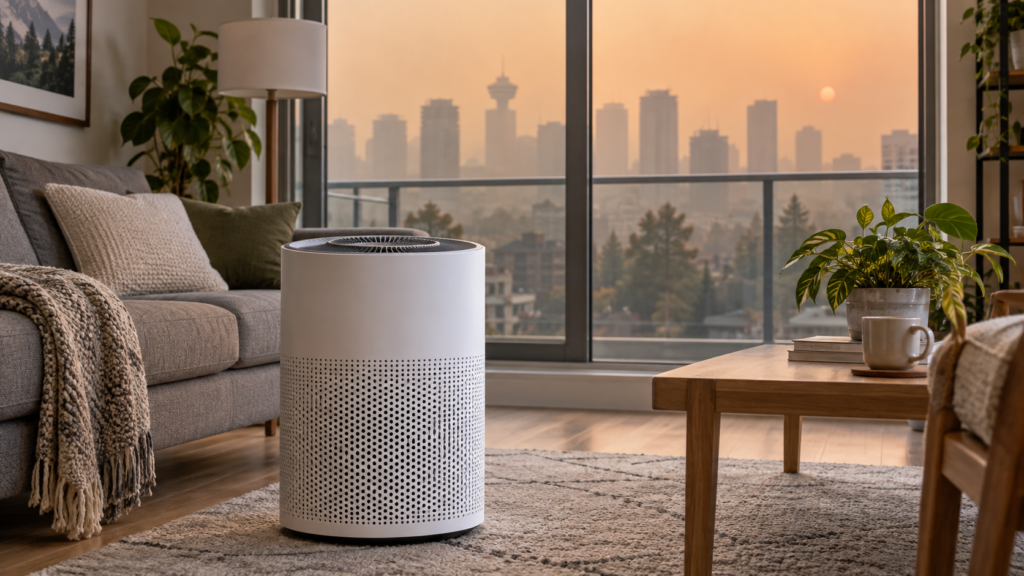
Choose a room large enough for the household but with as few windows and doors as possible. A bedroom, living room, or interior room can work, provided it has no fireplace or other source of indoor particles.
In a hot apartment without air conditioning, smoke protection and heat protection can conflict. If you must open windows to cool the space, do so when outdoor conditions are better, then close them and resume filtration as soon as possible. If you cannot keep the apartment both cool and reasonably smoke-free, consider a cleaner-air public building or another safe location.
For most apartments, start with the room where you sleep or spend the most time. Measure that room, multiply the square footage by 0.67, and choose a purifier with at least that tobacco smoke CADR. If the room has ceilings higher than 8 feet, increase the target. If you are protecting two separate rooms, use a unit in each room or move one larger unit according to where people are spending time.
For example, a 140-square-foot bedroom needs at least about 94 CFM of smoke CADR. A 250-square-foot living room needs at least about 167 CFM. Choosing somewhat more capacity—such as 120 CFM for the bedroom and 200 CFM or more for the living room—will generally give you more flexibility during severe smoke, provided the unit is suitable for the room and affordable to run.
In the United States, use the AirNow Fire and Smoke Map to follow local PM2.5 conditions. In Canada, follow local provincial or territorial air-quality information and public-health guidance. The purifier helps reduce indoor particle levels, but it does not make it safe to ignore evacuation orders, extreme heat, or serious breathing symptoms.
Check Canada’s local air-quality conditions
A. Not necessarily. Check the smoke CADR and the assumptions behind the coverage claim. A large advertised area may assume open rooms, low ceilings, and a particular air-change rate. Closed bedrooms and hallways usually need separate filtration.
A. Yes. Two units can be useful when you want to clean separate rooms, such as a living room and bedroom. For one open area, compare the combined smoke CADR, but remember that placement and airflow still affect performance.
A. No. HEPA describes the filter’s particle-removal efficiency, not the amount of air the device can process. You still need to check the smoke CADR or a credible room-size rating.
A. Generally, yes, if the device is designed for continuous operation and the filter and power cord are in good condition. Use the highest setting you can comfortably tolerate during heavy smoke, or a lower setting if noise prevents sleep.
A. Particle filtration can reduce much of the visible haze and particle-related smoke, while activated carbon may reduce some odours and gases. Odour removal depends on the amount and quality of carbon, so a purifier should not be judged by particle CADR alone for smell.
Featured image: K / Pexels / Pexels License