Welcome to KnowHow Daily!
Practical guides, money-saving tips, tech solutions, government benefits, and useful information for everyday life.
Welcome to KnowHow Daily!
Practical guides, money-saving tips, tech solutions, government benefits, and useful information for everyday life.

Compare three Canada federal student jobs for summer 2027, check eligibility, prepare documents, and apply before the October 28, November 2, and November 15 deadlines.

The Government of Canada has listed three specialized student opportunities for summer 2027 under the Federal Student Work Experience Program. They’re paid, full-time positions, but they aren’t interchangeable: one focuses on aquatic biology, one on marine search and rescue, and one on fisheries conservation and protection.
The first deadline arrives on October 28, 2026. The Canadian Coast Guard Inshore Rescue Boat program closes on November 2, 2026, followed by the Fishery Officer Student Program on November 15, 2026. Treat those as firm deadlines and submit early rather than waiting until the final evening.
| Program | Work period | Pay listed in posting | Deadline | Best fit for |
|---|---|---|---|---|
| Great Lakes Area Summer Fisheries Student Program | April 26 to September 3, 2027 | $17.75–$28.30 per hour | October 28, 2026 | Students interested in aquatic biology, fieldwork, laboratories, and fisheries research |
| Canadian Coast Guard Inshore Rescue Boat student program | Late April to early September 2027 | $20.16 per hour for crew members; $26.46 for coxswains | November 2, 2026 | Post-secondary students prepared for marine safety, emergency response, and shift work |
| Fishery Officer Student Program | May 3 to the end of August 2027 | $17.75–$31.69 per hour | November 15, 2026 | Students interested in conservation, fisheries operations, public education, and field support |
The listed pay is taken from the individual postings and may vary by classification or appointment details. Being eligible to apply doesn’t guarantee an interview or job offer.

The general Federal Student Work Experience Program rules require applicants to be registered as full-time students at an accredited secondary or post-secondary institution, meet the minimum employment age where the job is located, and return to full-time studies in the next academic term. Students with disabilities who are considered full-time by their institution may also qualify under the program’s student-status rules.
There’s a specific exception for some students in their final year: they must have previously worked under FSWEP, the federal Co-op/Internship Program, or the Research Affiliate Program. Don’t assume that graduating students qualify automatically.
Canadian citizens and permanent residents receive preference when they meet the job requirements. Other applicants may be considered when they’re legally eligible to work in Canada, but the individual posting and federal student-employment rules control the result.
Review FSWEP eligibility and student requirements
The Great Lakes program is administered by Fisheries and Oceans Canada, with positions based in Burlington and Sault Ste. Marie, Ontario. The posting lists 30 to 40 full-time jobs and says more than half of the positions are located in Sault Ste. Marie.
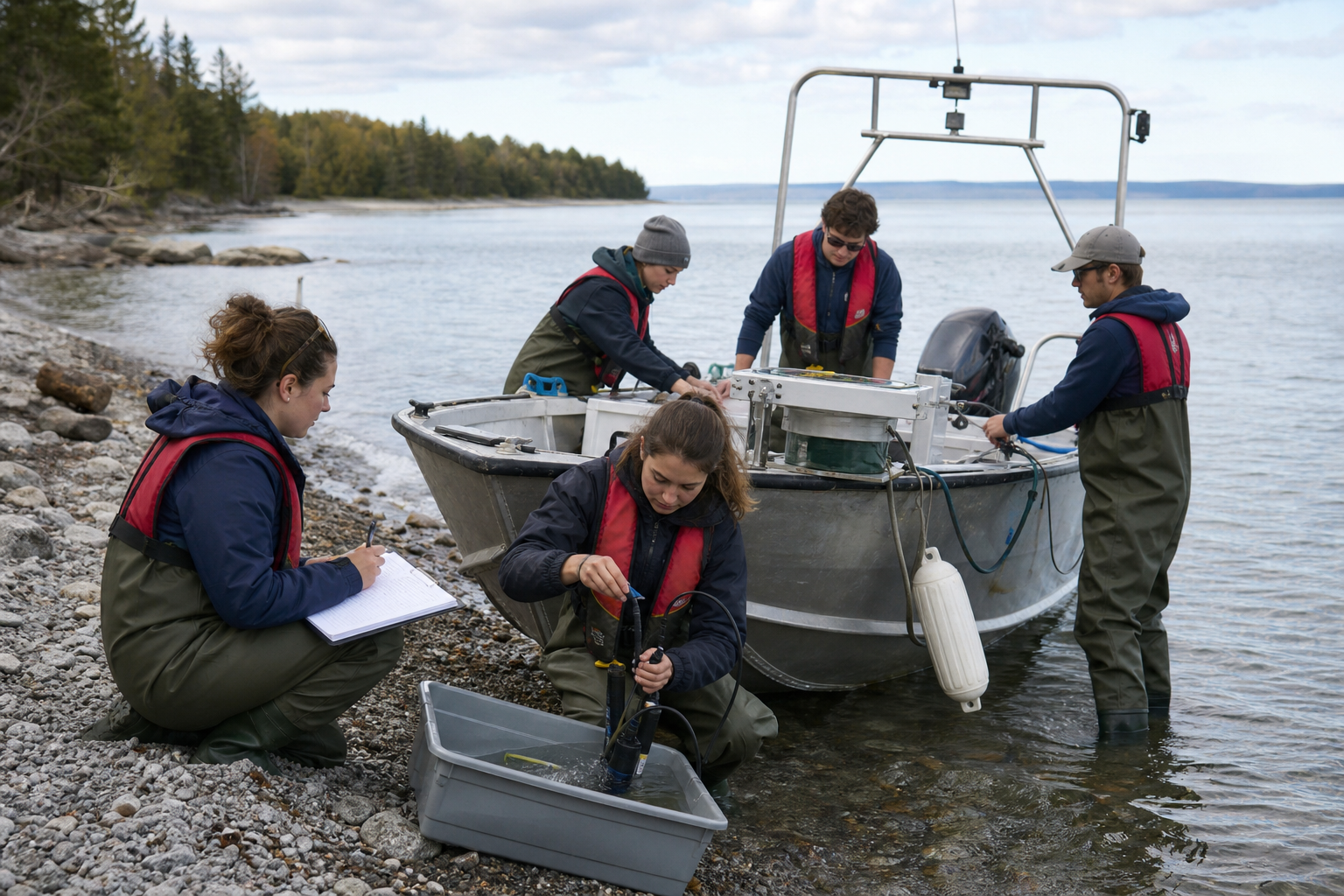
Students work with DFO teams to collect, process, and analyze fisheries data. The work can include sampling fish, water, sediment, invertebrates, mussels, and zooplankton; assessing tributaries; and supporting work related to species at risk and aquatic invasive species.
This is a strong match if you’re studying aquatic biology or a related field and don’t mind outdoor work, travel, changing weather, or occasional extended hours. The posting says applicants should have taken or be taking aquatic biology courses.
At the interview stage, candidates must provide a valid driver’s licence and a Pleasure Craft Operator Card. Successful candidates must also complete a Health Canada medical exam and obtain a government-issued reliability security clearance. Some duties may involve travel to or work in the United States, so certain positions may require a U.S. work visa.
Practical catch: DFO covers lodging and meals for many field assignments, but students are responsible for relocation and living costs when working in an office or laboratory setting.
The Inshore Rescue Boat program is the most operationally demanding of the three. Students train for at least 16 days before being assigned to a station, and the work can involve responding to disabled or capsized vessels, people overboard, and medical emergencies.
The program uses a rotating schedule of 14 consecutive days of work followed by 14 days of rest. During scheduled work periods, lodging and a shared meal budget are provided, but students are responsible for arrangements during their off-duty periods. Assignments may be different from a preferred region, so geographic flexibility matters.
Applicants must be full-time post-secondary students returning to full-time studies in fall 2027. The program also requires a valid Canadian driver’s licence, Standard First Aid with CPR-C/AED or an accepted equivalent, a Pleasure Craft Operator Card or accepted equivalent, and a Maritime Radio Certificate with VHF Digital Selective Calling endorsement.
Applicants must be able to work shifts, weekends, holidays, overtime, and in difficult weather conditions. The selection process can include a marine knowledge exam, interview, medical clearance, security status, and a paid training course with written and practical examinations.
The posting lists locations connected to Atlantic, Central, and Western regions, including stations in New Brunswick, Nova Scotia, Prince Edward Island, Newfoundland and Labrador, Ontario, Quebec, and British Columbia.
The Fishery Officer Student Program offers approximately 40 full-time positions across many Canadian communities, from British Columbia and Yukon to the Atlantic provinces and Quebec. Students support experienced Fishery Officers rather than working as independent officers.
Typical duties include public education, accompanying officers on patrols, managing fisheries-related materials, maintaining vehicles and equipment, answering public inquiries, preparing documents, and completing office and field support work.
The posting welcomes students from several backgrounds, including environmental or natural-resource management, marine and aquatic sciences, fisheries management, law enforcement, criminology, and public safety. Students from other disciplines may still apply if they meet the requirements.
This program has several conditions that deserve attention. Applicants must be at least 18 years old when employed, hold a valid Canadian driver’s licence, be physically able to regularly lift and carry 10 to 20 kilograms, and be comfortable standing, walking, hiking, working on vessels, and working outdoors in all weather. Shift work, weekends, holidays, overtime, travel, and remote or coastal assignments may be part of the job.
Housing and relocation assistance aren’t provided for this program. After the closing date, applicants will receive an invitation to complete a mandatory candidate profile through VidCruiter. Failing to complete that step within the stated timeframe means the application won’t move forward.
Set up a simple application folder now rather than gathering everything after a recruiter contacts you. Include:
For the Great Lakes position, highlight aquatic biology coursework and experience collecting or recording data. For the IRB program, put marine safety, boating, first aid, radio communication, and emergency-response experience near the top. For Fishery Officer roles, emphasize conservation, public interaction, judgment, documentation, and comfort working in both offices and outdoor environments.
Use the individual posting for the program you want. The application is completed online through the Government of Canada jobs website, not through a third-party job board.
For the Coast Guard program, applicants can expect communication within about one week of the closing date, according to the posting. If an application is selected, the candidate still has to complete the required assessments and training before employment is granted. For the Fishery Officer program, watch for the mandatory VidCruiter invitation after the deadline.
The biggest mistake is applying to the wrong program or assuming that a general FSWEP application automatically covers every specialized posting. These opportunities have separate postings and separate closing dates.
Another problem is overlooking the schedule. The Great Lakes position begins on April 26, 2027, while the Fishery Officer program begins on May 3. The Coast Guard program includes training shortly after the school year and may require a full-time operational commitment through early September.
Finally, don’t wait to obtain certifications if you’re targeting the IRB program. First aid, the Pleasure Craft Operator Card, radio certification, and an unrestricted driver’s licence are listed requirements. If you’re unsure whether your credential is accepted, use the official application contact listed in the posting before submitting.
Your safest next step is to choose the program that genuinely fits your education, schedule, location flexibility, and certifications, then submit the matching application before its exact 2026 deadline.
A. Possibly, but preference is given to Canadian citizens and permanent residents, and applicants must be legally eligible to work in Canada. The exact posting and federal student-employment rules determine whether a non-Canadian applicant can be considered.
A. The programs have separate postings, so you should submit a separate application for each opportunity that genuinely matches your qualifications and availability. Keep track of each deadline and tailor your résumé and screening answers.
A. The posting says candidates must provide a valid driver’s licence and a Pleasure Craft Operator Card at the interview stage. It also lists medical and reliability-clearance conditions.
A. The IRB posting says lodging and a shared meal budget are provided during scheduled work periods. It does not provide living arrangements or meals during off-duty periods, so applicants need to plan for those weeks.