Welcome to KnowHow Daily!
Practical guides, money-saving tips, tech solutions, government benefits, and useful information for everyday life.
Welcome to KnowHow Daily!
Practical guides, money-saving tips, tech solutions, government benefits, and useful information for everyday life.

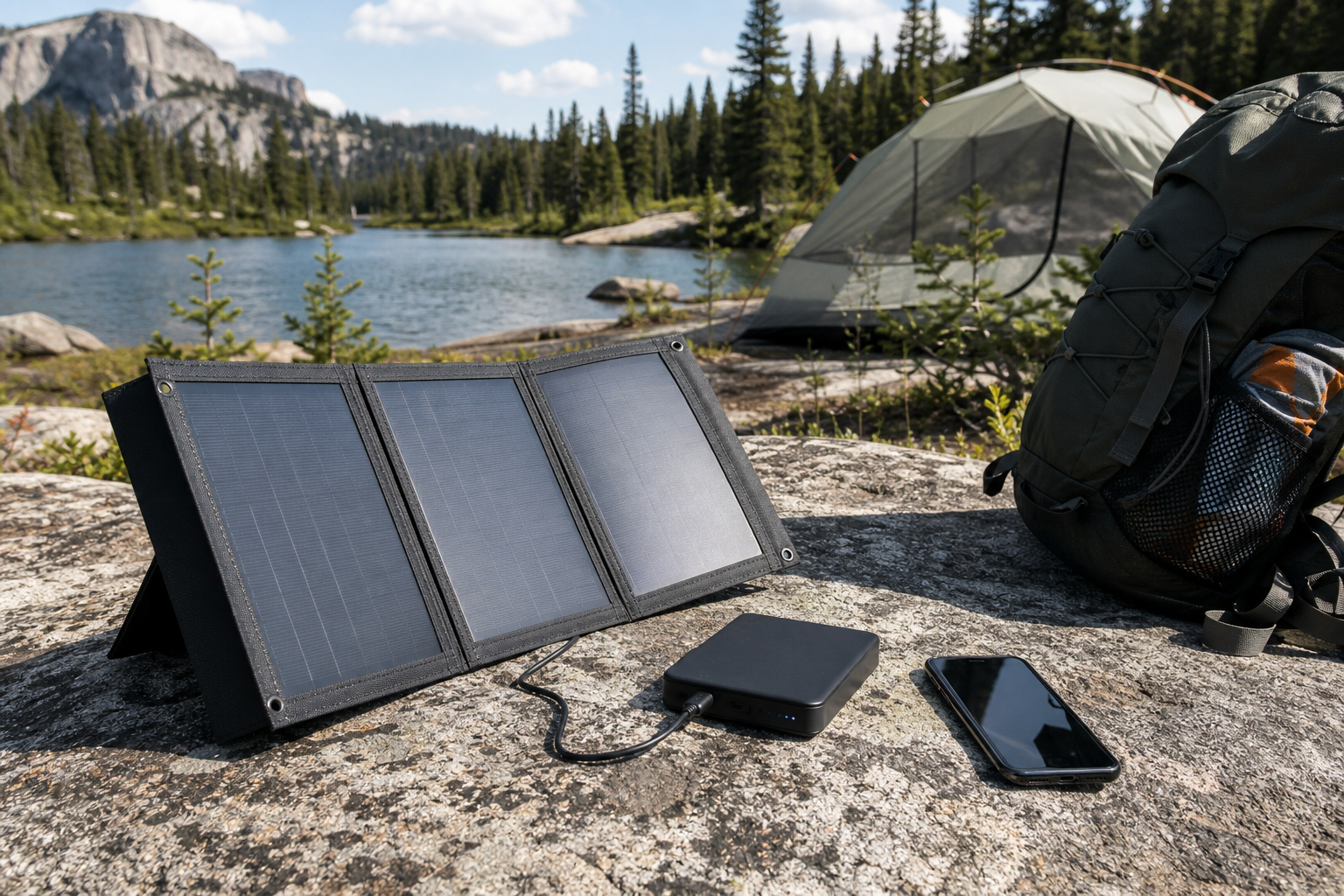
Learn how to choose a portable solar charger by panel wattage, battery capacity, USB-C output, weight, weather resistance, and realistic charging performance.
The best portable solar charger depends on whether you need emergency phone charging, a reliable power bank refill, or enough energy for a tablet, camera, or portable power station. For most people, the most practical setup is a foldable solar panel connected to a separate battery bank. The panel gathers energy when the sun is available, and the battery stores it for the evening, shade, or bad weather.
| Best fit | What to look for | Why it makes sense |
|---|---|---|
| Day hikes and occasional backup | 5W–10W panel or a compact solar power bank | Lightweight and adequate for topping up a phone over time, but slow in weak sunlight |
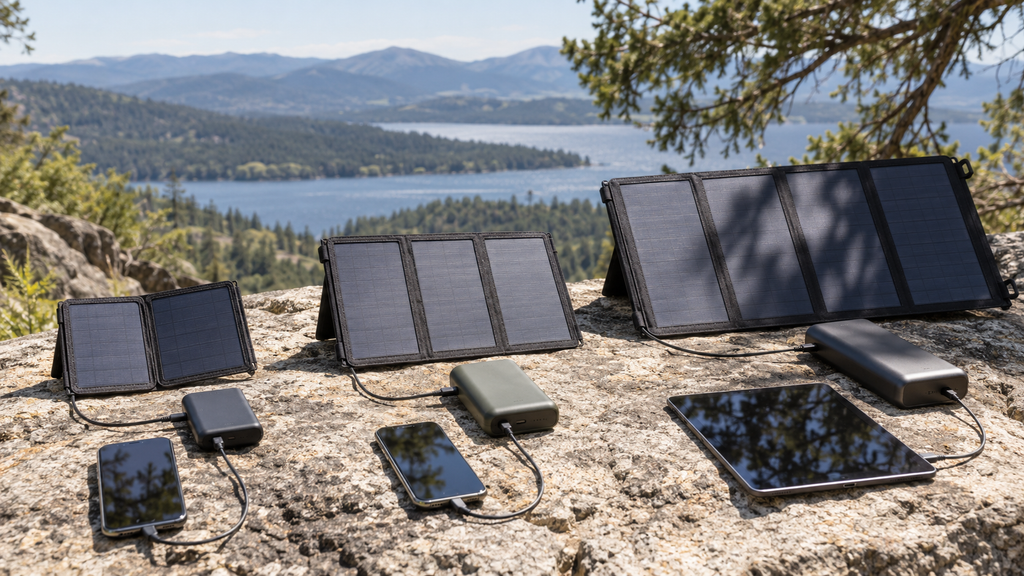
| Camping and travel | 15W–30W foldable panel plus a 10,000–25,000mAh power bank | Better balance of portability, storage, and useful daytime charging |
| Basecamp or outage preparation | 50W–100W panel plus a power station or large USB-C battery | More realistic for tablets, cameras, laptops, lights, and several devices |
These are buying categories rather than laboratory rankings. The examples below are based on published specifications and manufacturer documentation, not personal ownership or independent hands-on testing.
A useful solar charger has to do more than advertise a large wattage number. I looked at five practical factors: panel size, stored battery capacity, regulated output, USB-C capability, and packability. Weather resistance and connector compatibility also matter because a solar panel may be used around dust, rain, snow, and uneven ground.
Solar panel ratings are measured under standard test conditions. In real use, output changes with location, season, time of day, panel angle, temperature, shade, and cloud cover. The U.S. Department of Energy notes that thick clouds can eliminate direct sunlight and that real-world conditions are usually less favorable than laboratory ratings.
| Example | Published solar rating | Battery included | USB output | Best use |
|---|---|---|---|---|
| BioLite SolarPanel 10+ | 10W peak | 3,200mAh | USB-A, up to 10W | Compact backup charging with a small built-in battery |
| Goal Zero Nomad 20 | 20W | No | USB-A up to 10.5W; separate solar output | Charging a power bank or small devices at camp |
| BigBlue SolarPowa 28 | 28W rated; 20W working power | No | USB-A and USB-C, shared 5V output | Portable panel charging for phones and small electronics |
| Jackery SolarSaga 100W | 100W | No | USB-A and USB-C | Basecamp use and compatible portable power stations |
Specifications can vary by country, model revision, and retailer. Confirm the exact configuration before buying, especially when a product family includes several versions with different ports or connectors.
The BioLite SolarPanel 10+ is aimed at people who want one compact device rather than a separate panel and power bank. It combines a 10W panel with a 3,200mAh internal battery, a built-in kickstand, an alignment sundial, and IPX4 weather resistance. It weighs about 1.21 pounds.
View the official BioLite SolarPanel 10+ product page
That integrated battery is useful because you can collect energy while your phone is not connected, then charge the phone later. The trade-off is capacity: 3,200mAh is modest compared with a dedicated 10,000mAh or 20,000mAh power bank. It also uses USB-A rather than USB-C for device output, so it is less attractive if your kit is built around USB-C cables.
Choose it for short trips, emergency backup, or a simple all-in-one setup. Choose a larger separate battery if you need several phone charges or want to share power with other people.
The Nomad 20 is a 20W foldable panel without an integrated battery. It includes a USB port rated up to 10.5W and a separate solar output for compatible power banks and power stations. Goal Zero lists the panel at about 2.28 pounds and says it can charge phones, power banks, headlamps, lanterns, and small power stations.
This design makes sense for a camping kit because the panel and battery do different jobs. Leave the panel in the sun while keeping the battery protected in the shade. You can also use the stored energy after sunset instead of leaving a phone exposed to an intermittent solar connection.
The main limitation is USB-C support. The panel’s built-in USB port is USB-A, so USB-C devices may require a suitable cable or a separate battery with USB-C output. Its listed charging times are estimates and vary with temperature, elevation, time of year, angle, and sun position.
The SolarPowa 28 provides a larger folding panel with both USB-A and USB-C ports. BigBlue lists a 28W rated power figure, 20W working power, a shared 5V/4A total output, and a weight of about 1.48 pounds.
View the official BigBlue SolarPowa 28 product page
The USB-C port is convenient, but this is not the same as a high-wattage USB-C Power Delivery charger. Its published output is still limited to 5V, with the ports sharing available power. It is a reasonable choice for phones, battery banks, lights, and other small electronics, but it is not the right tool for fast-charging a USB-C laptop.
Because the output is regulated through the panel, it is generally more practical than plugging a phone directly into bare solar cells. Even so, moving clouds or shade can interrupt charging. A power bank remains the better buffer for unattended daytime charging.
A 100W folding panel is a different category from backpacking chargers. The SolarSaga 100W is designed for larger portable power setups and includes USB-A and USB-C ports for small electronics. It can also connect to compatible Jackery power stations with the required adapter.
This size is more useful when you need to refill a larger battery, run several devices at basecamp, or make meaningful progress during a limited sunny window. The trade-offs are bulk, setup space, and connector compatibility. Jackery warns that third-party panels must stay within the power station’s voltage and current limits, and some models require a specific adapter.
Choose this type when you have a vehicle, campsite, van, or fixed base. It is usually too large for a long backpacking trip.
Check the official Goal Zero Nomad 20 specifications
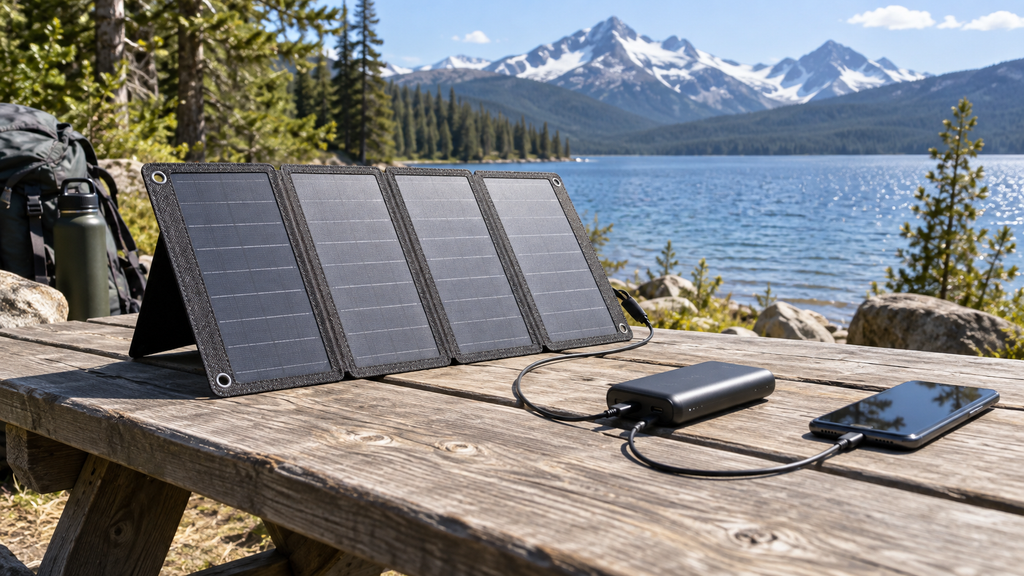
Panel wattage describes the maximum electrical power the panel can produce under specified test conditions. A 20W panel is not guaranteed to produce 20W every hour. Pointing it directly at the sun, keeping it unshaded, and adjusting the angle can make a large difference.
A small 5W–10W panel prioritizes weight. A 15W–30W panel is a practical middle ground for camping. Panels around 50W–100W are better suited to vehicles, basecamps, and power stations.
Battery capacity is commonly listed in milliamp-hours, but watt-hours are easier to compare across products. A 10,000mAh power bank rated at a nominal 3.7 volts represents about 37Wh before conversion losses. The energy available at its USB output will be lower because charging electronics and the battery itself are not perfectly efficient.
For a solo weekend, a 10,000mAh bank may be enough for careful phone use. A 20,000mAh–25,000mAh bank gives more breathing room for navigation, photos, communication, and multiple devices. Larger batteries add weight, so do not buy capacity you cannot realistically carry.
USB-C describes the connector, not the charging speed. Look for the actual output profile, such as 5V/3A, 20W, 30W, 60W, or 100W. USB Power Delivery is the standard to look for when you need higher-power charging for tablets, cameras, handheld gaming devices, or laptops.
Also check whether the USB-C port is an input, an output, or both. Some products include a USB-C port only for recharging the battery. Others support USB-C PD output but limit solar input to a much lower level.
Solar charging works best when you treat it as energy collection rather than an instant replacement for a wall charger. A phone connected directly to a panel may charge quickly in bright, stable sun, then stop or slow when a cloud passes. The same interruptions can confuse some devices or leave them repeatedly reconnecting.
For most trips, the dependable routine is to charge a power bank during the brightest part of the day and use the stored battery later. Keep the battery itself out of direct heat, protect it from rain unless it is specifically rated for exposure, and reposition the panel as the sun moves.
A 20W panel can theoretically produce 80Wh over four hours of perfect full-power operation, but that is a planning illustration, not a promise. Real output will be lower when the panel is angled poorly, partially shaded, hot, dusty, or under cloud. A 100W panel has more potential, but it also needs more open space and a compatible battery input.
Do not assume that a solar power bank with a tiny built-in panel will refill itself quickly. Its panel area is limited by the size of the battery case, so it is usually better at emergency top-ups than at fully recharging the battery from empty.
Confirm the exact model, panel rating, battery capacity, port direction, USB-C wattage, weather rating, folded dimensions, and weight. Check whether the listed wattage is peak, rated, or working output, and whether multiple ports share the available power.
For larger systems, verify the solar input voltage and current range before connecting a third-party panel. An incorrect connector may be inconvenient; an out-of-range voltage can prevent charging or damage equipment.
Finally, review the current seller, warranty, return policy, and regional product page. U.S. and Canadian listings may differ in stock, included adapters, warranty handling, and electrical terminology.
Verify official Jackery solar-panel compatibility guidance
Choose a compact solar power bank if your priority is emergency backup and minimum gear. Choose a 15W–30W foldable panel plus a separate power bank if you are camping or traveling and want the best balance of portability and usefulness. Choose a 50W–100W panel and a compatible power station when you need to collect enough energy for several devices, a basecamp, or an outage-preparedness setup.
A. A solar power bank is smaller and simpler, but its built-in panel is usually too small for fast recharging. A foldable panel paired with a separate power bank is generally more useful for camping because the larger panel collects more energy and the battery can store it for later.
A. Some larger panels and battery systems can support laptops, but the panel must provide compatible voltage and the battery or USB-C port must support the laptop’s required wattage. A USB-C connector by itself does not confirm laptop charging or USB Power Delivery support.
A. A 5W–10W panel can provide useful phone charging in strong sunlight, while a 15W–30W panel gives you more margin when the sun angle changes or light is less consistent. A separate power bank makes the setup much more reliable.
A. Only if the specific panel and its connections are rated for that exposure. Weather resistance may apply to the panel but not to the connected power bank, phone, cables, or power station. Check the manufacturer’s instructions and keep battery electronics protected unless their rating clearly allows outdoor use.