Welcome to KnowHow Daily!
Practical guides, money-saving tips, tech solutions, government benefits, and useful information for everyday life.
Welcome to KnowHow Daily!
Practical guides, money-saving tips, tech solutions, government benefits, and useful information for everyday life.

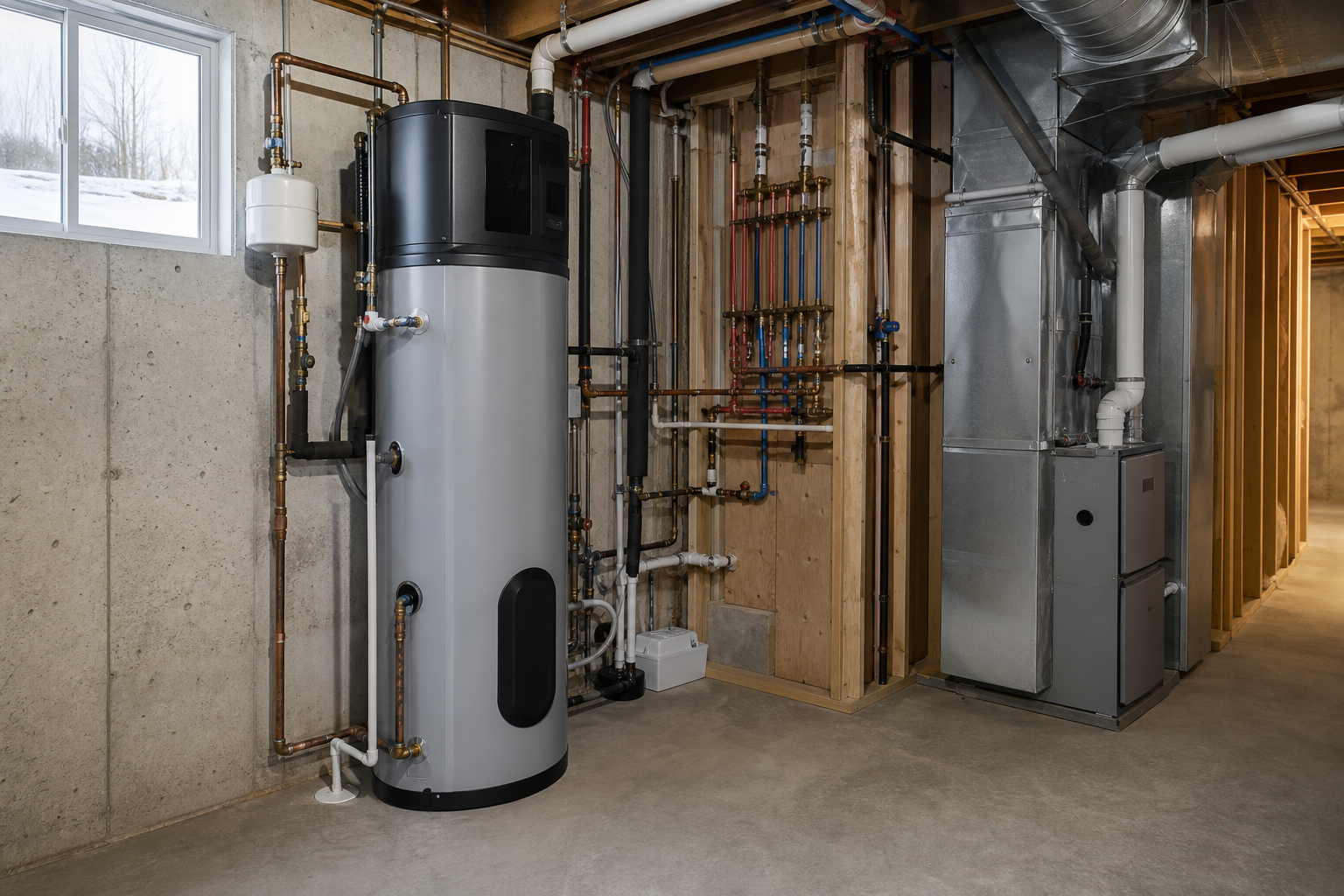
Learn how to choose a heat pump water heater for a cold basement or small utility room, including room volume, freezing risk, tank size, condensate, noise, and electrical requirements.
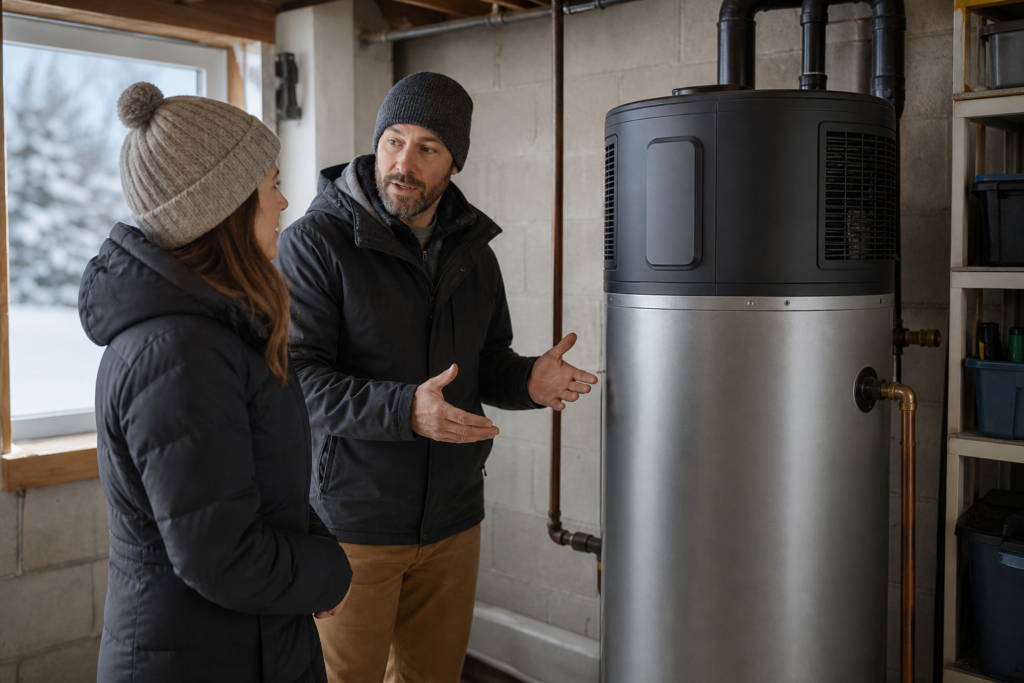
Yes—especially when the unit is installed in a basement or interior utility room that stays above freezing. A heat pump water heater, also called a hybrid electric water heater, uses a compressor and fan to pull heat from surrounding air and transfer it into the tank. It uses electricity, but it does not create all of that heat with resistance elements.
The key distinction is that a cold climate does not automatically rule out a heat pump water heater. The installation space matters more than the outdoor temperature by itself. A heated or moderately warm basement can be a good location in Minnesota, Michigan, Maine, Ontario, Quebec, and similar regions. An unheated garage that can approach freezing during winter may be a poor choice unless the specific model and installation method are designed for those conditions.
ENERGY STAR guidance says many models need roughly 450 to 700 cubic feet of surrounding air, while other guidance uses approximately 750 to 1,000 cubic feet depending on the model and setup. Treat those numbers as screening ranges, not universal rules. The installation manual for the exact model controls.
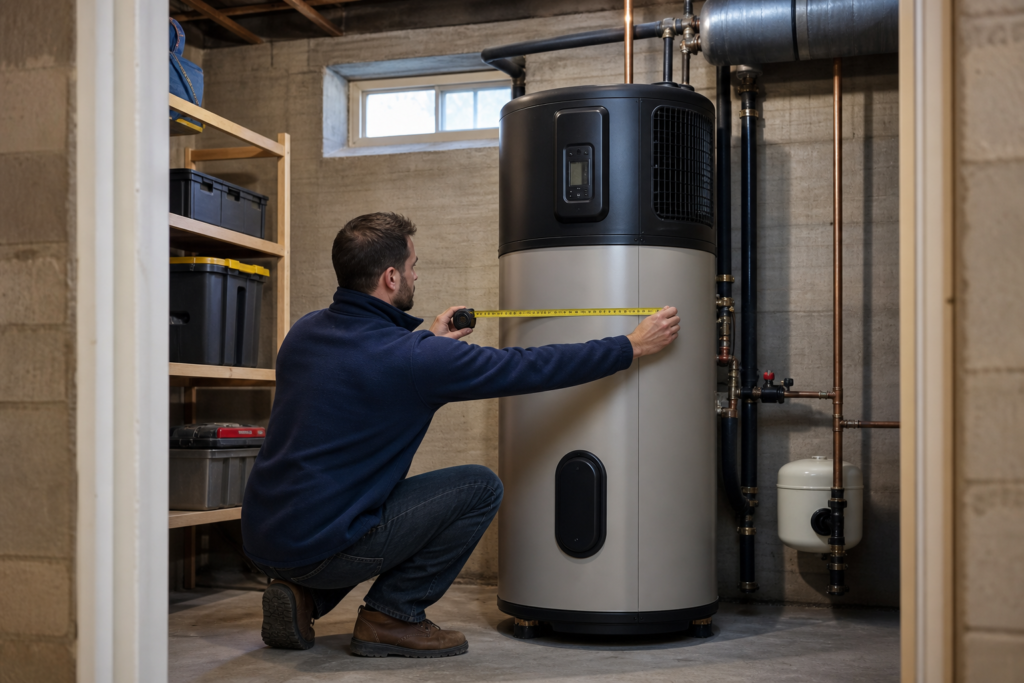
Measure the room before comparing models. Multiply the room’s length, width, and height to estimate its cubic volume. For example, a 10-by-10-foot room with a 7-foot ceiling contains 700 cubic feet.
That calculation is only the starting point. The heater also needs clearance for air intake, cool-air exhaust, service access, plumbing, and removal of the old tank. A tall unit may not fit beneath low basement ductwork or shelving, even when the room has enough total volume.
An unfinished basement often provides enough air volume and is less exposed to freezing temperatures than a detached or attached garage. A location near a furnace or other warm mechanical equipment can also provide useful waste heat.
Even an unconditioned basement should be checked during the coldest part of winter. Protect the tank, water lines, condensate tubing, and drain components from freezing. A basement that has previously experienced frozen pipes, prolonged power outages, or very low temperatures deserves extra scrutiny before installation.
Garages can provide plenty of air volume, but cold-climate garages create two separate problems: the water heater may operate less efficiently in very cold air, and water or condensate lines may freeze. ENERGY STAR identifies garages as more suitable in warmer climates and recommends considering freezing conditions in cooler regions.
Do not assume that placing an insulated blanket around the tank solves the problem. The heat pump needs access to surrounding air, and the installation manual may prohibit certain insulation or enclosure arrangements. If the garage is the only available location, ask the installer specifically about minimum operating temperature, freeze protection, drain routing, and winter outage conditions.
Sometimes. A small room is not automatically disqualified, but it may need an approved airflow solution. Depending on the product, that could include a fully louvered door, transfer grilles, ducting to another space, or a model designed for a smaller installation volume.
A closed closet with a standard solid door is usually the most difficult arrangement. The heater may not have enough air to operate efficiently, and the room can become noticeably cooler while the unit runs. Do not cut vents into a door based on a generic internet recommendation. The required opening size, location, and duct arrangement must come from the manufacturer’s instructions and local code.
Small rooms also make sound and service access more important. The compressor and fan produce a low mechanical hum, and the unit may sound louder in a hard-surfaced closet. Avoid placing it directly against a bedroom or living-room wall when possible. Leave enough room for filter cleaning, anode or component service, plumbing work, and eventual replacement.
Review the official ENERGY STAR design considerationsHeat pump water heaters commonly come in larger tank sizes than the electric resistance heater they replace. That is often intentional. The heat pump saves energy when it does most of the work, but resistance elements may operate during periods of heavy demand or when the tank needs faster recovery.
Use your household’s actual hot-water pattern rather than choosing only by the number printed on the old tank. Consider the number of residents, back-to-back showers, baths, teenagers, a large soaking tub, frequent laundry, and whether guests regularly stay in the home.
Compare the model’s rated storage volume and first-hour rating. The first-hour rating estimates how much hot water the system can deliver during a high-demand period, combining stored hot water with recovery. A larger tank can reduce the need for resistance backup, but it also requires more floor space and may weigh more when full.
| Household situation | What to prioritize |
|---|---|
| One or two people with moderate use | Correct room fit, lower sound, and adequate first-hour rating |
| Three or more people | Adequate storage volume and recovery, not just the tank’s nominal size |
| Several showers close together | A larger tank, high first-hour rating, and a suitable operating mode |
| Limited utility-room space | Exact dimensions, service clearances, and possible split or ducted designs |
Heat pump water heaters remove heat from the surrounding air, so colder room air can reduce performance and may cause the system to use its electric resistance backup more often. That does not make the technology unsuitable for northern homes, but it changes the economics and the best installation location.
For a basement installation, check whether the room normally stays within the model’s published operating range. ENERGY STAR consumer guidance commonly points to spaces around 40°F to 90°F, while individual products may specify different limits. The manufacturer’s installation guide is the deciding document.
For Canadian homeowners, Natural Resources Canada describes HPWHs as systems that draw heat from air in places such as basements and utility rooms. Its guidance also emphasizes choosing the right size and using qualified professionals. Product availability, electrical rules, permits, and incentive requirements can differ by province and territory.
In the United States, ENERGY STAR certification is a useful starting filter, but certification does not guarantee that every model is suitable for a particular cold basement or closet. Compare the installation manual, operating-temperature range, first-hour rating, sound rating, and service requirements.
Browse certified heat pump water heater models Compare Canadian heat pump water heater informationBecause the unit cools and dries air, it produces condensate. The water is generally clean and non-acidic, but it still needs a reliable drain path.
A basement installation may use a floor drain, utility sink, laundry sink, approved plumbing connection, or condensate pump. Gravity drainage is preferable when practical. The drain line should not rise above the heater’s condensate outlet, and it must be protected from freezing if it passes through a cold area.
Do not assume the existing water-heater pan is an acceptable condensate drain. A safety pan is intended to catch leaks, not normally to receive continuous condensate discharge. Ask the installer to show you exactly where the condensate will go and what happens if the drain or pump becomes blocked.
Many heat pump water heaters use a 208- or 240-volt circuit, but the breaker size and wiring requirements vary. Some models are designed for a 30-amp circuit, while lower-power products may use a 15-amp circuit with different recovery characteristics.
If you are replacing an electric tank, the existing circuit may be useful, but it still needs to be checked against the new model’s instructions. If you are replacing gas, oil, or propane equipment, you may need a new electrical circuit and possibly panel work. Have a licensed electrician evaluate capacity rather than assuming the panel has room.
Plumbing work may include a drain pan, expansion tank, shutoff valve, temperature-and-pressure relief piping, flexible connections, and code-required seismic or restraint measures. The exact requirements depend on the jurisdiction and product.
Before ordering a heat pump water heater for a cold-climate basement or small utility room, ask the installer to confirm each item below in writing:
A heat pump water heater is worth serious consideration if you are replacing an electric tank, have a basement or interior utility room that stays above freezing, and can provide the required airflow and drainage. It is a less straightforward choice when the only available location is a freezing garage, a very tight closet, or a room where cool exhaust air and compressor noise would be disruptive.
The most reliable decision rule is simple: select the installation location first, then choose a model that fits that location and your household’s hot-water demand. Do not buy the tank first and hope the room can be adapted later.
A. Usually, yes, if the basement stays above freezing, provides the required air volume and clearances, and has a suitable condensate drain. Check the exact model’s installation manual because minimum room temperature and airflow requirements vary.
A. It can lower the temperature of the installation room while operating because it removes heat from the air. The effect depends on room size, insulation, operating time, and household hot-water use. A basement near a furnace or other warm equipment may be a better location than a cold isolated room.
A. No, but a small closet may need manufacturer-approved louvers, transfer grilles, ducting, or a model designed for lower available air volume. A solid-door closet with no airflow path is unlikely to be suitable.
A. It may be possible with some products and installation methods, but it is a higher-risk location in a cold winter climate. Verify the model’s minimum operating temperature, protect the tank and pipes from freezing, and plan condensate drainage so the line cannot freeze.
A. Not always, but a larger tank can help the heat pump handle peak demand with less reliance on electric resistance backup. Compare your household’s usage with the model’s storage volume and first-hour rating rather than matching the old tank automatically.